COMBAT FIELD TEST
CFT Training: How to Train for the Combat Field Test
Seven events, one clock, 30 minutes. How to prepare for each CFT event and rehearse the full sequence.
Good CFT training builds running fitness first and strength second. It ends with practice of all seven events back to back. The test is one running clock, so your plan must end with full sequence rehearsals in uniform and boots.
This guide explains what the test asks and how to prepare for each event. It also gives you a weekly plan. Every rule here comes from Army Directive 2026-07, signed 17 April 2026. armygrader.com is an independent site with no link to the U.S. Army.
CFT Requirements Under Army Directive 2026-07
The CFT requirements are short. You finish seven events in order, and your total time must be 30 minutes or less. The Army announcement confirms that standard.
Army Directive 2026-07 lists the events in this order:
Order | Event | What it demands |
|---|---|---|
1 | 1-mile run | Aerobic pace while fresh |
2 | 30 dead-stop push-ups | Pressing strength from a full stop |
3 | 100-meter sprint | Speed after the first two events |
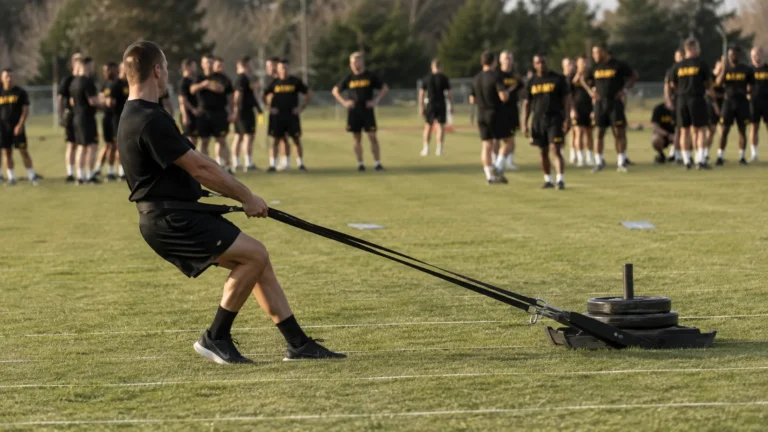
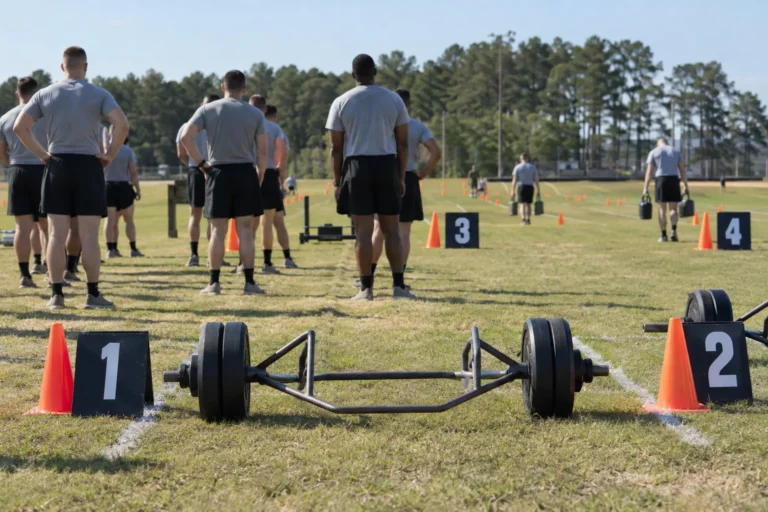
4 | 16 sandbag lifts, 40 pounds each, onto a 65-inch platform | Repeated lifting to chest height and above |
5 | Water can carry, two 5-gallon cans at 40 pounds each, for 50 meters | Grip and trunk strength under load |
6 | 50-meter movement drill: 25-meter high crawl, then 25 meters of 3-5 second rushes | Getting down and up fast |
7 | Second 1-mile run | Aerobic pace on tired legs |
Source: Army Directive 2026-07, paragraph 4a(3).
How is the combat field test scored?
The CFT has no points. No single event gets its own time. The grader tracks one clock from the start of the first mile to the end of the second. You pass if that total is 30 minutes or less. The standard is the same for every age and both sexes, according to the Army’s AFT and CFT page.
You must finish each event before you move on. If you cannot complete an event, the test ends and counts as a failure. The directive also allows no event changes for soldiers on profiles.
What do you wear for the CFT?
The answer to “what do you wear for the cft” is set in the directive. You wear the ACU top and bottom, a brown t-shirt, and combat boots. No headgear is worn. The fitness uniform is not an option for this test.
Who has to take the CFT test?
Soldiers in the 24 combat specialties listed in the directive take the cft test. Check the full list of 24 specialties if you are unsure about yours.
Regular Army and AGR soldiers take one CFT and one AFT each year. So do Reserve Component soldiers on active-duty orders of 365 days or more. Other Reserve Component combat soldiers alternate, with a record AFT one year and a record CFT the next. The CFT does not replace the AFT. See how the two tests fit in one year.
Here is how the two tests compare on the cft standards that matter most for planning:
Factor | CFT | AFT |
|---|---|---|
Scoring | Pass or fail on total time | 0 to 100 points per event |
Standard | 30 minutes or less | 60 per event; 350 total for combat specialties |
Uniform | ACU, brown t-shirt, combat boots | Physical fitness uniform |
Events | Seven, run back to back | Five, scored separately |
Age and sex | One standard for all | Age-normed; combat standard is sex-neutral |
Sources: Army Directive 2026-07; AFT Scoring Scales, effective 1 June 2025.
How to Train for the Combat Field Test, Event by Event
Search “how to train for the combat field test” and you find plenty of circuits. Most treat the army combat field test like a gym workout. The better approach groups the events by what they demand. Three groups cover all seven.
Running work for the combat field test
Two miles and a sprint make up most of your time. Build easy mileage first, then add one interval session and one tempo run each week. Run some of those miles in boots once your feet adapt. Our pace tool for the mile runs helps you set split targets.
Practice the sprint after push-ups. Your arms and chest will be tired, and your first steps will feel slow.
Push-ups and the sandbag lift
Dead-stop push-ups start each rep from a full stop on the ground. Train them that way, since bouncing reps build a different habit. Add weighted push-ups or bench press for pressing strength.
The sandbag lift moves 40 pounds to a 65-inch platform, 16 times. Train deadlifts, cleans and push presses to build the pull from the ground and the drive overhead. Practice with a real sandbag, since the load shifts as you lift it.
The water can carry and movement drill
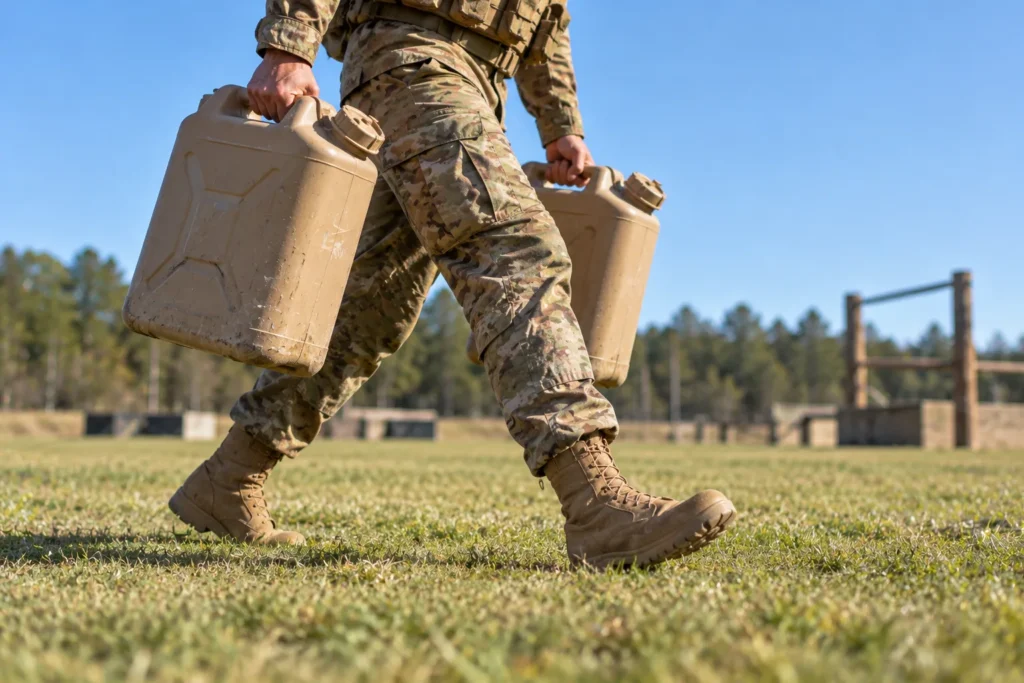
Your water can carry uses two 5-gallon cans at 40 pounds each. Farmer’s carries with heavy dumbbells or kettlebells build the grip you need. Walk fast and keep your shoulders set.
For the movement drill army units teach the high crawl and the rush. The rush uses 3-5 second bounds: up, sprint, and down again. Practice getting to the ground and back up quickly. Do it in ACUs on grass so your elbows and knees adapt.
Train the transitions
The clock never stops between stations. Walking slowly from the push-up area to the sprint lane costs real time. Practice moving straight from one event to the next.
Rehearse your setup at each station too. Know how you will grip the sandbag and pick up the cans before test day. Small delays add up across seven events.
Build a Weekly CFT Training Plan
Start with separate event work, then join the events together. Plan on three training blocks.
Block one builds the base. Run three or four times a week, mostly easy. Lift twice a week with deadlifts, presses and carries. Practice push-ups and the high crawl in short sets.
Next, pair the events in block two. Run a mile, then do push-ups and a sprint. On another day, do sandbag lifts straight into a carry and the movement drill. The pairs teach you how fatigue from one event affects the next.
The final block adds a full back-to-back sequence rehearsal once a week, in uniform and boots. Time every rehearsal. Keep one easy run and one strength day in the same week.
Budget your 30 minutes
No official event splits exist, so any budget is your own planning tool. Here is a provisional example. If each mile takes 9:00, the two runs use 18:00. That leaves 12:00 for the five middle events and the moves between them. Slower miles leave less time for the stations.
Time each rehearsal by station. The slowest station tells you what to train next week. Once you have run the sequence, time your seven-event sequence against the standard.
Here is a sample week for the final block. Adjust the days to fit your unit schedule.
Day | Session |
|---|---|
Monday | Full sequence rehearsal in ACUs and boots, timed |
Tuesday | Easy run |
Wednesday | Strength: deadlifts, presses, heavy carries |
Thursday | Intervals, then dead-stop push-ups |
Friday | Sandbag lifts, water can carry and movement drill, paired |
Weekend | Rest or an easy walk |
Plan the CFT Around Your AFT
You still owe a record AFT each year, so plan both tests on one calendar. Regular Army and AGR soldiers need at least 4 months between a record CFT and AFT. Long-tour Reserve Component soldiers follow the same rule. For other Reserve Component combat soldiers, the gap between record fitness tests is 8 months.
Use that gap. Shift your plan toward the deadlift, plank and two-mile run in the weeks before your AFT. Shift back to loaded carries and uniform work before your CFT. Neither test requires you to pass the other first.
Gear and Boots for Training
Train in the gear you will test in. Wear the same combat boots, authorized under AR 670-1, that you will wear on test day. Break them in well before your record test.
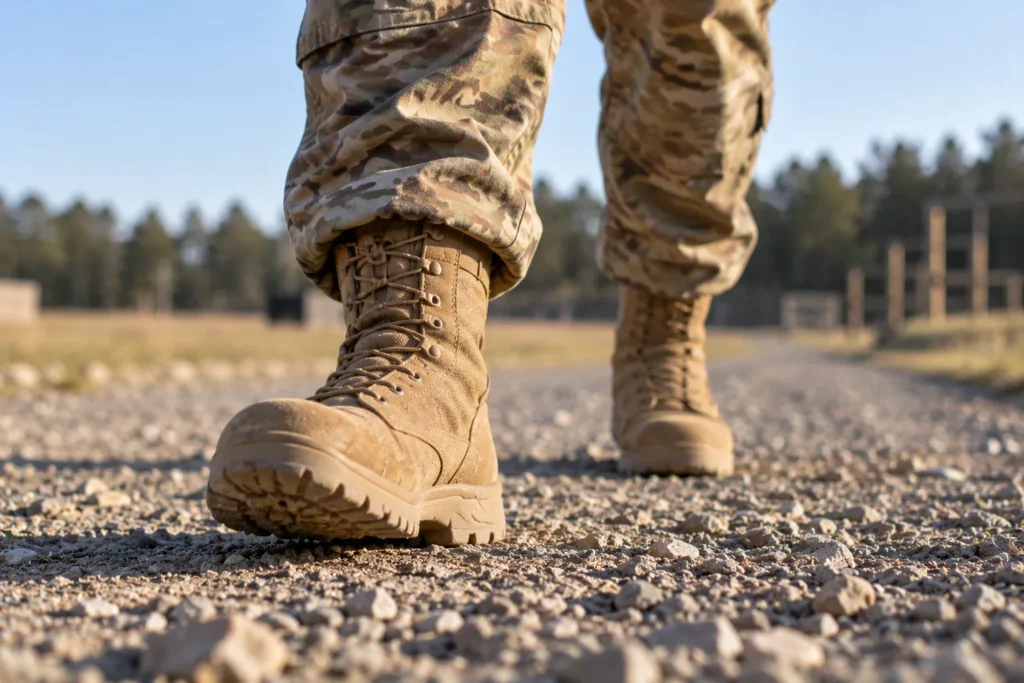
Run in ACU trousers at least once a week in the final block. The fabric and boots change your stride. You also want to know how your uniform handles the high crawl.
What Happens If You Fail the CFT?
The directive set a one-year implementation period. During that year, a failed CFT alone brings no administrative action. After it ends, failure brings flagging and reconditioning training under FM 7-22.
You must retest within 90 days. Reserve Component soldiers who are not AGR or on long active-duty orders get 180 days. Enlisted soldiers who fail two CFTs in a row can face separation if they cannot reclassify. Officers face a similar process.
Profiles change the picture. A permanent profile that blocks any primary AFT event makes you ineligible for the CFT. You are then evaluated for reclassification, and a general officer can grant a waiver. Read our guide to how profiles affect Army fitness testing for the details.
Frequently Asked Questions
Start Your CFT Training This Week
Pick your weakest event group and start there. Build your cft training around that group for the first block, then join the events. Before your record test, plan your splits with our CFT tool. Then score your five AFT events so you stay ready for both tests.