EVENT TRAINING
Sprint Drag Carry: Cutting 20 Seconds Off Your Time
Where the sprint-drag-carry standards actually come from, the fixed sled and kettlebell weights, and where most soldiers lose their time.
Most soldiers lose the sprint drag carry on the sled and the four turns, not on the sprints. Fix your drag position, your turns, and your kettlebell grip. Twenty seconds inside eight weeks is realistic for anyone with those faults.
That number is a coaching estimate, not an Army figure. It applies to soldiers who currently drag upright, take wide turns, and set the kettlebells down. If your form is already clean, expect smaller gains.
The SDC is the third of the five events listed in the AFT Scoring Scales, approved 15 May 2025 and effective 1 June 2025. It is scored on total time. Lower time, more points. You can score all five events together once you know your split.
Sprint drag carry quick facts. The numbers people search for most, in one place.
Fact | Answer |
|---|---|
Distance | 250 m: five 50 m shuttles, each 25 m out and back |
Order | Sprint, drag, lateral, carry, sprint |
Sled | 90 lb |
Kettlebells | Two, 40 lb each |
Time limit | 4 minutes |
100 points (age 17-21, male/combat) | 1:29 |
60 points (age 17-21, male/combat) | 2:28 |
Place in the AFT | Event 3 of 5 |
Distance, order, weights and the 4-minute limit come from the Army Fitness Test page on army.mil. Point times come from the table below.
Sprint Drag Carry Standards by Age Bracket
Sprint drag carry standards run from 0 to 100 points on a single time scale. Those standards shift with your age bracket and with the column you are graded on.
The AFT Scoring Scales use ten age brackets: 17-21, 22-26, 27-31, 32-36, 37-41, 42-46, 47-51, 52-56, 57-61, and Over 62. You move brackets on your birthday.
There are two scoring columns, not three. One column covers male soldiers and the combat standard. The second column covers female soldiers on the general standard.
Age bracket | 60 pts (M / Combat) | 100 pts (M / Combat) | 60 pts (F) | 100 pts (F) |
|---|---|---|---|---|
17-21 | 2:28 | 1:29 | 3:15 | 1:55 |
22-26 | 2:31 | 1:30 | 3:15 | 1:55 |
27-31 | 2:32 | 1:30 | 3:15 | 1:55 |
32-36 | 2:36 | 1:33 | 3:22 | 1:59 |
37-41 | 2:41 | 1:36 | 3:27 | 2:02 |
42-46 | 2:45 | 1:40 | 3:42 | 2:09 |
47-51 | 2:53 | 1:45 | 3:51 | 2:11 |
52-56 | 3:00 | 1:52 | 4:03 | 2:18 |
57-61 | 3:12 | 1:58 | 4:48 | 2:26 |
Over 62 | 3:16 | 2:09 | 4:48 | 2:26 |
Source: AFT Scoring Scales, approved 15 May 2025.
Sixty points is the floor on every event. Miss it on the SDC and the test is a failure, whatever your other four scores say.
The general standard is 300 total. The combat standard is 350 total. The 300 is simple arithmetic, 60 points across five events. It is not a separate gate you clear on top of the event minimums.
Army Directive 2026-07, dated 17 April 2026, brought the combat MOS list to 24. It added 12D Army Diver, 89D EOD Specialist and 89E EOD Officer, and designated all three combat for the AFT as well as the Combat Field Test. Soldiers in those MOSs are scored sex-neutral and age-normed on the male column above.
You can compare your bracket against the one above and below it to see how much slack you gain with age.
How the SDC Army standards changed under the AFT
The Army Combat Fitness Test was replaced on 1 June 2025 under Army Directive 2025-06. The new test has five events, not six. The Standing Power Throw is gone. Maximum total is 500 points.
The SDC survived that change. The distances, the sled and the kettlebells did not move. What changed is the test around it and the point tables it feeds.
Two widely shared training sites still describe this event as Event 5 of the six-event ACFT. Both halves of that are wrong. There is no six-event ACFT, and the SDC is not the fifth event.
The AFT has five events, and the AFT Scoring Scales list the SDC third, after the deadlift and the hand-release push-up. Even under the retired six-event test, the SDC ran fourth, not fifth. Use Army Directive 2025-06 and the current scoring scales, not an ACFT-era article.
Sprint drag carry sled weight: what you actually pull
The sled weighs 90 pounds. You pull the 90-pound sled backward for 25 meters, cross the far line with the whole sled, then pull it back. Nothing is added or removed for age or column.
The sprint drag carry kettlebell weight is two 40-pound kettlebells, one in each hand, per the Army’s published event description. You carry them the full 50-meter shuttle without setting them down.
Both loads are fixed. That matters for training. You cannot scale the weight down on test day, so you train at the real load or you find out the hard way.
The five shuttles, in order
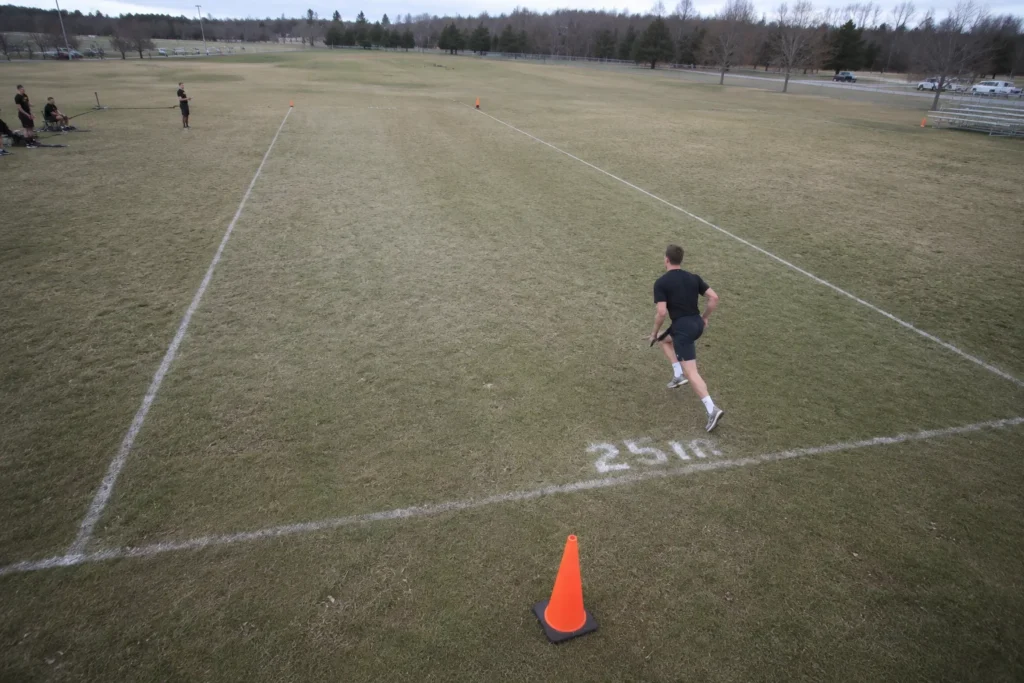
The event is five 50-meter shuttles run back to back with no rest. Each 50-meter shuttle is 25 meters out and 25 meters back.
- Sprint
- Sled drag
- Lateral shuffle
- Kettlebell carry
- Sprint
That totals 250 meters. Touch the turnaround line with a hand or a foot at every transition. The clock runs from the start command until you cross the finish after the last sprint.
The lateral shuffle is the segment soldiers rehearse least. You face the same direction for the full 50 meters and shuffle both ways. Your feet do not cross.
Where do most soldiers lose time on the SDC?
Most time is lost on the drag and on the four turns. Soldiers stand too tall on the sled, slow down before the line instead of through it, and reset their grip mid-carry. Those faults cost more than raw sprint speed does.
The sprints bracket the event, but they are only 100 of the 250 meters. Shaving a tenth off your 25-meter dash is hard. Fixing a bad drag angle is not.
Segment | Slow version | Fast version |
|---|---|---|
Opening sprint | Full effort, no plan for what follows | Hard but controlled, breathing set for the drag |
Sled drag | Upright torso, short choppy steps | Low hips, long backward strides, straps tight |
Turnarounds | Wide arc, decelerate early | Plant, pivot tight, accelerate off the line |
Lateral shuffle | Bouncing high, feet crossing | Low and flat, feet never crossing |
Kettlebell carry | Bells swinging, grip resets | Bells tight to the hips, one grip start to finish |
Final sprint | Nothing left in the tank | Paced earlier so the last 50 is real |
The drag is where the biggest single gain sits. Lean back against the strap and let your body weight do the work. Keep the sled moving, because restarting a stopped 90-pound sled costs seconds every time.
Turns are the quiet killer. Four turnarounds at one wasted second each is four seconds off your score for free.
Does grip strength decide your SDC time?
Grip strength does not decide the event, but it caps the carry. If the kettlebells slip or you set them down, you lose several seconds and restart from a dead stop. Farmer carries and heavy holds fix this faster than general forearm work.
Anaerobic capacity is the larger limiter for most soldiers. The SDC sits in the window where lactate builds and pace collapses. That capacity is trainable, and it responds inside a few weeks.
How to get faster at sprint drag carry
Train the event itself, not a substitute for it. Most soldiers who plateau have never pulled a real sled at 90 pounds.
Drag work
Pull the sled twice a week. Do four to six sets of 25 meters at test load with full recovery between sets. Film one set from the side and check your torso angle.
If no sled is available, use a weighted sandbag on a tarp. The angle and the leg drive transfer even when the friction does not match.
Anaerobic capacity
Run 30-second efforts with 90 seconds of rest, six to eight rounds. Build toward shorter rest as the weeks pass. This is the work that keeps your last sprint from falling apart.
Hill sprints do the same job with less joint stress. Keep the effort near maximum and the rest honest.
Turns and transitions
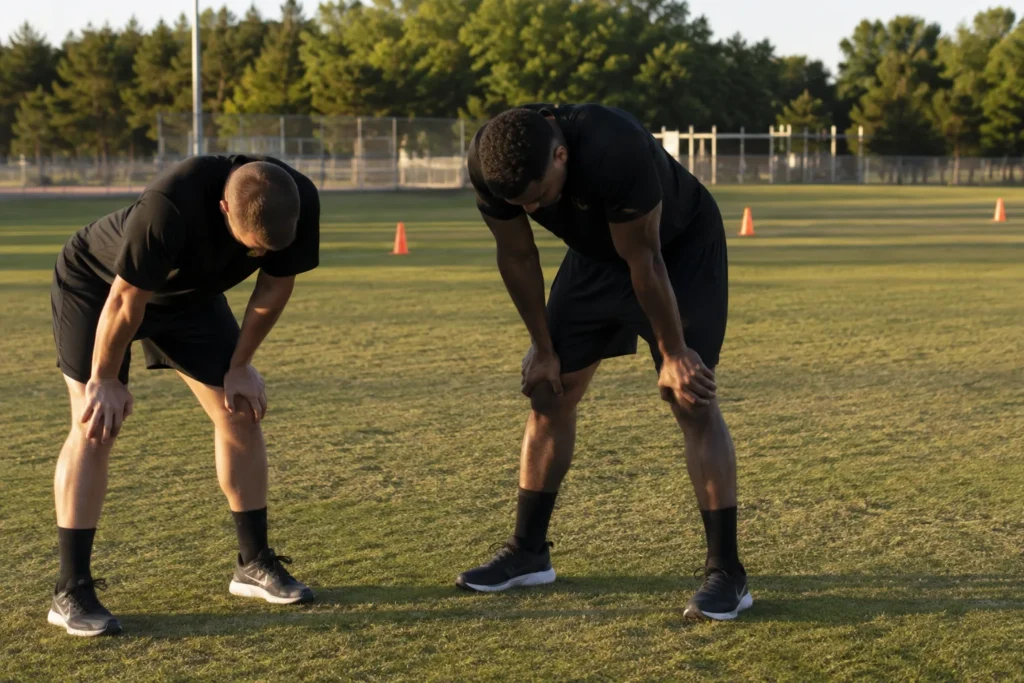
Set out cones at 25 meters and drill turnarounds alone. Twenty tight turns in a session builds a habit the clock rewards. Practice the handoff from drag to shuffle and from carry to sprint, since both are where soldiers hesitate.
Full rehearsals
Run the whole event once every two weeks, timed, in the order above. More often than that and you are testing rather than training. Put each rehearsal time into the calculator so you can watch the point gain rather than the raw seconds.
Should you pace the first sprint?
Yes, slightly. Going flat out on the opening 50 meters costs you on the drag, which is the longest and heaviest segment. Aim for roughly 90 percent on the first sprint and bank the difference. Soldiers who empty the tank early almost always crawl through the final shuttle.
What is the sprint drag carry time for 100 points?
For a male or combat-standard soldier aged 17-21, the maximum is 1:29. It sits at 1:30 for the 22-26 and 27-31 brackets, then eases to 2:09 for Over 62. On the female column the 100-point time is 1:55 through the 27-31 bracket and 2:26 at the top brackets.
Very few soldiers reach those times. A more useful target is the 90-point mark, which for a 17-21 male or combat-standard soldier is 1:43. The 80-point mark for that same bracket is 1:53.
Chasing the maximum here has a cost. Ten points on the SDC is worth the same as ten points on the deadlift, and the deadlift is usually easier to move. Look at the full point tables for the other four events before you decide where your training time goes.
Only a certified grader entering your result into the Digital Training Management System produces an official score. Your DA Form 705 record follows what the grader submits, not your stopwatch.
Frequently Asked Questions
What to do next
Pick the two faults from the table above that match your last run. Work them for six weeks, then time a full rehearsal and log it.
Your sprint drag carry time is the most trainable score on the test, because so much of it is technique rather than fitness. Enter your rehearsal result and your target total to see exactly how many seconds stand between you and the next point band. Then take the same numbers to the published scale for the other events and decide where the rest of your training goes.
armygrader.com is an independent reference site. It is not affiliated with, endorsed by, or connected to the U.S. Army or the Department of Defense. Always confirm standards with your unit master fitness trainer and the current AFT Scoring Scales.