BODY COMPOSITION
What Replaced the Army Height and Weight Standards
The height and weight tables and the tape test were rescinded on 7 July 2026. One waist-to-height ratio under 0.550 is the whole standard now.
The Army height and weight tables are gone. Army Directive 2026-13 rescinded them on 7 July 2026, along with the tape test. One number replaced both. Your waist divided by your height must come in under 0.550.
Nothing else counts toward the Army height and weight assessment anymore. Not your scale weight. Not your age. Not your gender. Not your fitness test score.
This post covers what changed, what the new measurement looks like, and what happens if you miss it.
Most of the confusion out there comes from pages that were written before July and never updated. Check the directive number and the date on anything you read.
Army Height and Weight Standards Now Run on a Single Ratio
The Army height and weight standards use waist-to-height ratio, written WHtR, and nothing else. Secretary of the Army Dan Driscoll signed Army Directive 2026-13 on 1 July 2026. It took effect 7 July 2026 and made WHtR the sole authorized measurement under the Army Body Composition Program.
The directive covers the Regular Army, the Army National Guard, and the U.S. Army Reserve. It also covers cadets at West Point and Senior ROTC, retention actions, and institutional training courses.
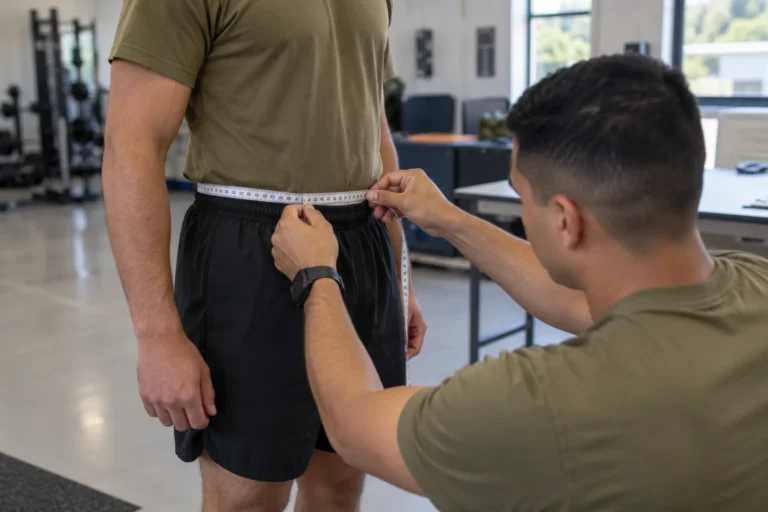
Here is the math. Measure your waist at the navel in inches. Measure your height in inches. Divide waist by height. A result under 0.550 meets the standard.
A result of 0.550 or higher does not. The directive sets program enrollment at 0.550 or greater. The threshold is less than, not equal to.
One line applies to every soldier. There are no age brackets and no separate male and female columns. A 19-year-old private and a 48-year-old sergeant first class hit the same number.
That single line is the biggest practical change. The old system needed three inputs before it could tell you anything: your height, your weight, and your age bracket. If you cleared the screening table you stopped there. If you did not, you moved to a second assessment with its own formula and its own pass line.
Now there is one step. You either come in under 0.550 or you do not.
The Army has described the change as aligning body composition with medically validated health measures. It is part of a wider Department of War effort to run one consistent standard across the services. Waist-to-height ratio is already the screening measure the other branches use.
What Changed and What Stayed
Item | Before 7 July 2026 | Now |
|---|---|---|
Screening step | Height and weight screening table by age and gender | None. WHtR is measured directly |
Body fat method | One-site tape test at the navel | None. WHtR replaces it |
Supplemental assessments | DXA, InBody, Bod Pod on request | Not authorized |
Fitness test exemption | 465 or higher on the AFT exempted you | Rescinded. No exemption exists |
Recording form | DA Form 5500 and DA Form 5501 | DA Form 5500 only |
Governing regulation | AR 600-9 | AR 600-9, as modified by Army Directive 2026-13 |
Assessment frequency | Twice per calendar year | Twice per calendar year |
AR 600-9 has not disappeared. It still governs enrollment, counseling, and administrative actions until the Army rewrites it. Army Directive 2026-13 sits on top of AR 600-9 and overrides the parts it names. The directive is rescinded once the revised regulation publishes.
The waist measurement location did not change. Graders still measure at the navel. What changed is what happens to that number.
It used to feed a formula that estimated body fat percentage. That estimate then went against a maximum allowable percentage set by your age and gender. Now the same waist number gets divided by your height and compared to one threshold.
Assessments still run at least twice per calendar year. Your commander can also direct a measurement at any time. That happens if there is reason to think you do not meet the standard.
If you want to see where your own measurement lands, the waist-to-height ratio tool runs the current math.
The Tape Test and the Forms That Went With It
Every version of the tape test is rescinded. The one-site method and the older multi-site method are both retired. Every supplemental body fat assessment went with them on 7 July 2026, including DXA, InBody, and Bod Pod scans.
You will still find tape test Army guidance in old smart books, unit SOPs, and study sites. None of it describes a current requirement.
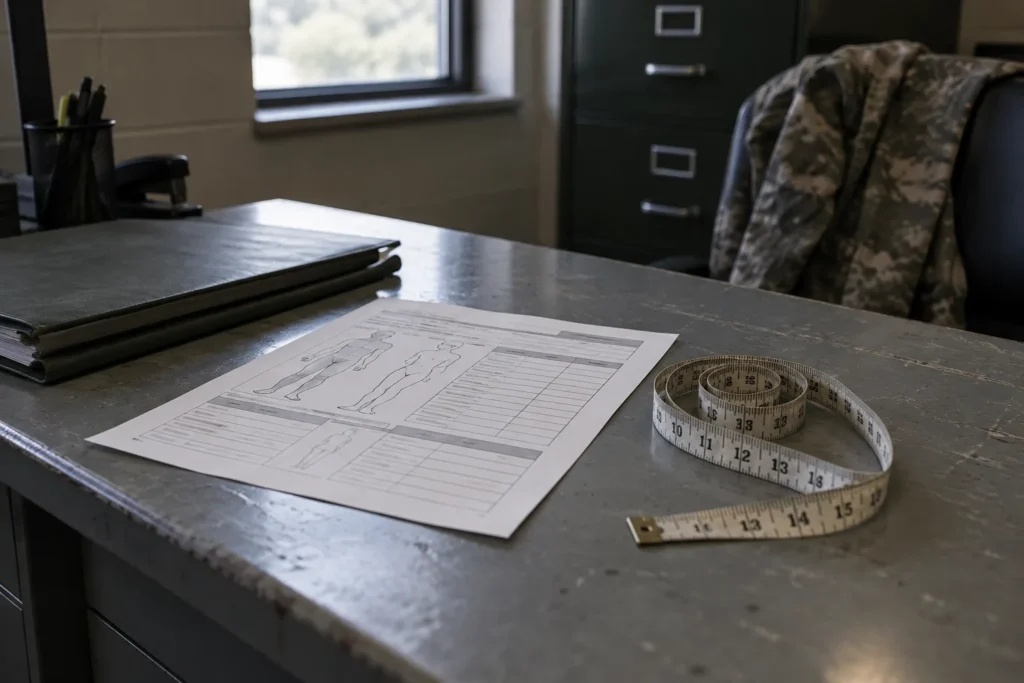
You also cannot use the tape test to challenge a WHtR result. Under the old rules, a soldier who failed the screening table could tape out and pass. That second chance is closed.
Army Directive 2026-13 bars circumference-based assessment from contesting a waist-to-height ratio. No other body fat method can contest it either. If your recorded ratio is 0.550 or higher, there is no alternate assessment that overrides it.
That is a real change in how the program feels day to day. A lot of soldiers cleared body composition every year on the tape after failing the scale. That option no longer exists.
The forms split two ways. DA Form 5500 stayed. Your WHtR gets recorded on it and logged in the Army Training Information System. DA Form 5501 was the female version of the body fat worksheet, and DA Form 5501 is rescinded outright. The current standard has no gender-specific version, so a second form served no purpose.
How the One-Site Tape Test Worked
The one-site tape test arrived with Army Directive 2023-11 in June 2023. It measured abdominal circumference at the navel and combined that with body weight to estimate body fat percentage.
Before that, the Army ran a multi-site method. Graders taped neck and waist for men, and neck, waist, and hips for women. Each result went against a maximum allowable body fat percentage set by age bracket and gender.
Both methods are history now. You may still need them for a records review or an old counseling packet. The numbers survive in archived AR 600-9 tables for that purpose only.
Neither method produces a valid assessment today, no matter who administers it. The same pattern shows up across Army fitness policy, and the full history of test changes lays out how often the standards have turned over.
How Do You Measure Waist-to-Height Ratio for the Army?
Measure your waist at the navel and your height, both in inches, then divide waist by height. Take the result to three decimal places. Under 0.550 passes. The Army does not round the third decimal, so a value of 0.5498 is recorded as 0.549 and passes.
That truncation rule matters more than it sounds. EXORD 182-26 Annex A directs that the value will not be rounded. Digits past the third decimal are disregarded.
Work an example. A soldier calculates 0.549888. The recorded value is 0.549, and he passes. A phone calculator would show 0.55 and scare him for nothing.
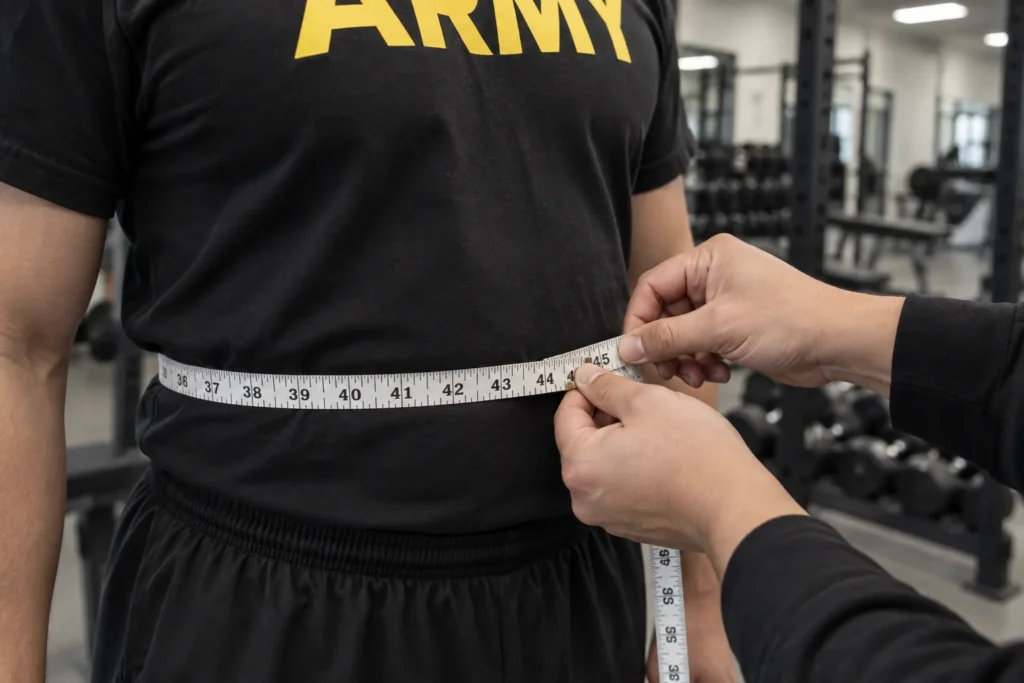
Both measurements have to use the same unit. Inches with inches, or centimeters with centimeters. Mixing them produces a meaningless number.
Commanders must allow at least seven days between your Army Fitness Test or Combat Field Test and your WHtR assessment. The gap exists so one event does not distort the other. Few soldiers know this rule. If your unit tries to tape you the morning after a record AFT, that seven-day window is worth raising.
Stand upright with your arms relaxed at your sides. Keep the tape level all the way around and snug without compressing. Breathe normally and take the reading at the end of a normal exhale.
EXORD 182-26 Annex A: Who Measures You and How
EXORD 182-26 Annex A is the Army’s step-by-step measuring guide. These are the parts most Soldiers never see:
Who measures: two trained members, an NCO or above or a trained Army civilian, of the same sex as you where possible. If an opposite-sex measurer is used, a same-sex Soldier must be present.
Tape: a non-stretch fiberglass tape. Cloth and steel tapes are not allowed.
Clothing: PT shorts, T-shirt and socks. Height is taken in socks, without shoes, to the nearest half inch.
Waist: at the navel, level, starting on your right side. If a skin fold covers the navel, the measurer marks the fold and measures across it.
Readings: three. If one differs from the other two by more than 1 inch, a fourth is taken and the three closest are averaged. Each reading is rounded down to the nearest half inch.
Waist Measurement That Produces a 0.550 Result
This table shows the waist size where your ratio hits exactly 0.550 at common heights. That figure is a failing result, not a passing one. You need to come in below it.
Height | Waist that produces 0.550 |
|---|---|
5’2″ (62 in) | 34.1 in |
5’4″ (64 in) | 35.2 in |
5’6″ (66 in) | 36.3 in |
5’8″ (68 in) | 37.4 in |
5’10” (70 in) | 38.5 in |
6’0″ (72 in) | 39.6 in |
6’2″ (74 in) | 40.7 in |
6’4″ (76 in) | 41.8 in |
A soldier at 70 inches with a 38.5 inch waist calculates exactly 0.550 and fails. At 38.0 inches the same soldier calculates 0.542 and passes.
Your unit measurement is the one that counts. Anything you run at home is preparation, not a record. You can check your own ratio in seconds before your unit schedules you.
What Happens If You Fail the Waist-to-Height Standard?
An initial result of 0.550 or higher triggers a confirmation measurement. A different measurement team has to re-measure you on the same duty day before your commander takes any action. If the confirmation also lands at 0.550 or higher, you get flagged and enrolled in the program.
The flag is Flag Code K, noncompliance with the Army Body Composition Program. It is non-transferable. Army Directive 2026-13 amended AR 600-8-2 on this point. The old provisions letting a program flag move with a soldier on reassignment are struck.
Enrollment works differently than it used to. Mandatory monthly assessments and formal progression requirements are rescinded. Your commander decides when to reassess you. You come off the program administratively as soon as you meet the standard.
Separation is on hold. Units may start separation actions for a soldier flagged under the program. No soldier gets separated yet. Headquarters, Department of the Army must first finish a 180-day assessment of the new standard and publish further guidance.
Read that carefully. The pause covers separation, not the flag. You can still be flagged, still lose a school seat, and still sit out a promotion board while the review runs.
Do Army Weight Standards Still Affect Your Record?
Your weight is no longer measured for body composition, so army weight standards in the old sense do not exist. What still hits your record is the flag. An active Flag Code K blocks promotion, school seats, and favorable personnel actions the same way it always did.
The old army weight standards worked through a screening table. It compared your scale weight to your height, age, and gender. That table is discontinued. Weight, age, and gender are not inputs to the current calculation at all.
Your fitness test result sits in a separate lane now. A high score no longer buys you anything on body composition. A body composition flag does not change your AFT score either. If you are working on the fitness side, the five-event score breakdown shows what each event pays.
What Else Army Directive 2026-13 Rescinded
The headline is the tape test, but the directive cleared out more than that.
Three prior directives came off the books. Army Directive 2025-17 carried the AFT score exemption that let a 465 or better skip body composition. Army Directive 2023-11 established the one-site body fat assessment. Army Directive 2023-08 held the older ACFT score exemption. All three are rescinded.
The requirement for commanders to appoint a non-commissioned officer as ABCP administrator is also gone. Commanders now own oversight, quality control, and execution directly inside their units.
One deadline still applies. Every soldier must have a WHtR recorded on DA Form 5500. It also goes into the Army Training Information System within 90 days of the directive. Leaders enter results using the ATIS Leader Tool. After that catch-up, the normal twice-yearly cycle runs.
Published sources disagree on the exact calendar date for that mark. Some count from the 1 July signature. Others count from the 7 July effective date. Ask your S-1 rather than trusting a countdown clock on a website.
The policy is not retroactive. Prior program actions taken under the tape test are not reopened by Army Directive 2026-13. A soldier flagged in March 2026 under the old method does not get that action erased. He gets measured against the new standard going forward.
Recording is the part soldiers forget. The same rule applies to fitness results, where only a certified grader entering a score counts. Our guide to what makes a result official covers how that works.
Where the Wrong Dates and Numbers Come From
Three errors are still circulating, and each one has a specific cause.
Sites still showing the tape test as current. Several military study and test-prep pages still walk through the one-site tape test. They show the neck and waist measurements and the age-based body fat table as though you will be graded on them. You will not. Army Directive 2026-13 rescinded all of it on 7 July 2026. Here is a quick test. If a page shows a body fat percentage table with age brackets and no rescission notice, it is out of date.
Pages dating the change to 1 January 2026. That date is wrong. Army Directive 2026-13 was signed 1 July 2026 and took effect 7 July 2026. Nothing about Army body composition changed on 1 January 2026. The confusion likely comes from the separate AFT administrative-action timeline. That one did carry a 1 January 2026 date for active duty and AGR soldiers. Two different policies, two different dates.
The 0.55 versus 0.550 problem. Plenty of pages write the threshold as 0.55 and call it “0.55 or below.” That reading fails soldiers who land exactly on the line. The directive sets ABCP enrollment at 0.550 or greater. Exactly 0.550 is a failing result.
Soldiers searching for what replaced the Army height and weight standards run into all three versions. Check the directive number and the date on any page before you act on it.
The 2026 Documents and Where to Get Them
Document | What it does | Date |
|---|---|---|
Sets WHtR under 0.550 as the only standard; ends the tables, the tape test and the 465-point exemption | Signed 1 Jul 2026, effective 7 Jul 2026 | |
Step-by-step measuring procedure | Posted 7 Jul 2026 | |
Army answers on timing, failure, flags and forms | Posted 7 Jul 2026 | |
The form your measurement is recorded on | Current |
AR 600-9 is still in force, but Army Directive 2026-13 replaced its tables and tape test. To check your own number, use our Army body fat calculator.
Frequently Asked Questions
What to Do Next
Measure your waist at the navel and your height, both in inches, and divide. If your ratio sits close to 0.550, you have a real target. You also have a specific number of inches to work toward.
The Army height and weight assessment is now the simplest it has ever been to check on your own. Run the number, write it down, and ask your readiness NCO when your unit is scheduling assessments.
Also confirm your result is recorded in ATIS. The directive gave every soldier a 90-day window to get one on the books. A missing record is an administrative problem you do not want.
Start by running your current ratio. Then score your last fitness test and work out where your points are sitting, so you know both halves of your readiness picture.
armygrader.com is an independent reference site. It is not affiliated with or endorsed by the U.S. Army or the Department of Defense. Your unit’s recorded measurement is the official result. Sources: Army Directive 2026-13 (signed 1 July 2026, effective 7 July 2026), AR 600-9, EXORD 182-26 Annex A, and the Army Body Composition Program FAQ published on army.mil. Last reviewed 3 September 2026.