AFT TRAINING
Your 8-Week Army PT Plan for the AFT
Four training days a week, two build blocks and a light test week, covering all five AFT events.
This army pt plan gives you eight weeks to prepare for all five Army Fitness Test events. You train four days a week, build load in two blocks, and finish with a light test week.
The AFT replaced the ACFT on 1 June 2025 under Army Directive 2025-06. It has five events: the three-repetition maximum deadlift, hand-release push-up arm extension, sprint-drag-carry, plank and two-mile run (army.mil). Each event scores 0 to 100 points. You need at least 60 on every event.
Most Soldiers must reach 300 total, which is simply 60 on all five. Soldiers in the 24 combat MOSs listed under Army Directive 2026-07 must reach 350. That combat standard is sex-neutral and uses the male scoring column.
Before week 1, run a baseline mock test. Then score each practice event so you can see where your points are thin.
How the 8-Week AFT Training Plan Is Built
This AFT training plan runs in two four-week blocks. Weeks 1 to 3 build volume, and week 4 is a deload week.
Weeks 5 to 7 raise intensity. Week 8 tapers into test day. The whole 8 week AFT training plan rests on progressive overload. You add a little load, a few reps or a faster pace each week, so your body keeps adapting.
The structure follows the Army’s Holistic Health and Fitness system, known as H2F. FM 7-22, Holistic Health and Fitness, sets the Army’s doctrine for Soldier readiness training (WRAIR fact sheet). The drills themselves are laid out in ATP 7-22.02.
Every session opens with the Preparation Drill. It warms your joints and muscles before heavy pulls or sprints. Each session closes with the Recovery Drill. It lowers your heart rate and stretches the muscles you just worked.
Weeks | Phase | Focus | Effort |
|---|---|---|---|
1 to 3 | Build | Technique, volume and aerobic base | Moderate |
4 | Deload | Same lifts and runs, about half the volume | Easy |
5 to 7 | Intensify | Heavier deadlift triples, faster intervals | Hard |
8 | Taper | Short sessions and one light mock test | Easy |
Plan structure:Built on FM 7-22 and ATP 7-22.02 drill guidance.
A deload week matters because hard training piles up fatigue. Keep the same exercises in week 4 but cut the sets. You start week 5 fresh instead of worn down.
In weeks 1 to 3, aim for clean reps over heavy ones. Film a deadlift set and a push-up set to check your form. Build your weekly running time slowly, with most miles at an easy pace.
Weeks 5 to 7 shift the focus to test speed. Deadlift sets get heavier with fewer reps. Intervals get shorter and faster. Run one full mock test at the end of week 6. Then shape week 7 around your lowest-scoring event.
What is the best workout plan for the AFT?
The best workout plan for the AFT trains all five events every week and fixes your weakest event first. Scoring under 60 on any single event fails the whole test. A strong run cannot rescue a weak plank. Four balanced training days will serve you better than six days spent only on running.
Check your baseline against the scoring scales for your age bracket to find that weak event. The AFT scoring scales use ten age brackets, from 17-21 up to Over 62. An army pt plan that ignores your bracket can leave you chasing the wrong target.
Your Weekly AFT Workout Plan
This AFT workout plan uses four training days. Rest, walk or stretch on the other three.
Day | Session | Events it builds |
|---|---|---|
Monday | Deadlift strength and push-up sets | Deadlift, push-up |
Tuesday | Run intervals and drag or carry work | Sprint-drag-carry, run |
Thursday | Accessory strength, planks and carries | Plank, sprint-drag-carry, deadlift |
Saturday | Long easy run | Two-mile run |
Event names: Army Directive 2025-06
Monday is your heavy day. Work up to hard sets of three on the hex bar deadlift, since the event tests a three-rep maximum. Follow with hand-release push-up sets, stopping each set two reps short of failure.

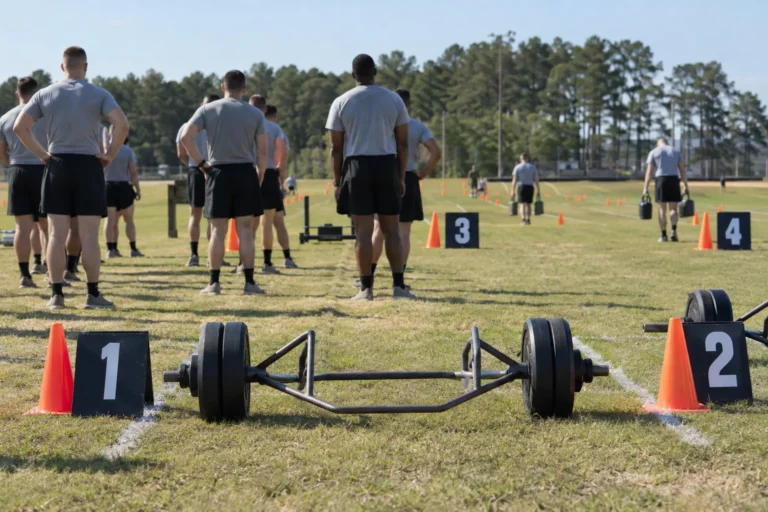
Tuesday builds speed. Run short intervals a little faster than your goal two-mile pace. Then drill pieces of the sprint-drag-carry. The event uses a 90-pound sled and two 40-pound kettlebells (goarmy.com). Train with similar loads where your gym has them.
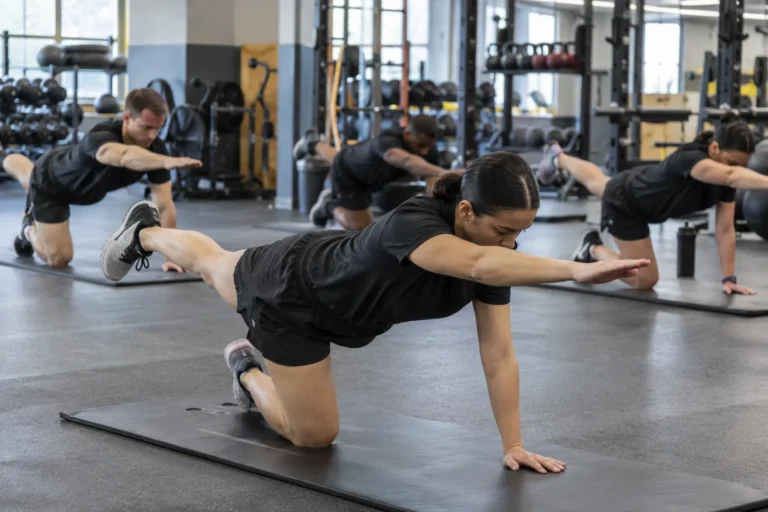
Thursday fills the gaps. Add rows, split squats and farmer’s carries for grip. Hold the plank in timed sets and add a few seconds each week.
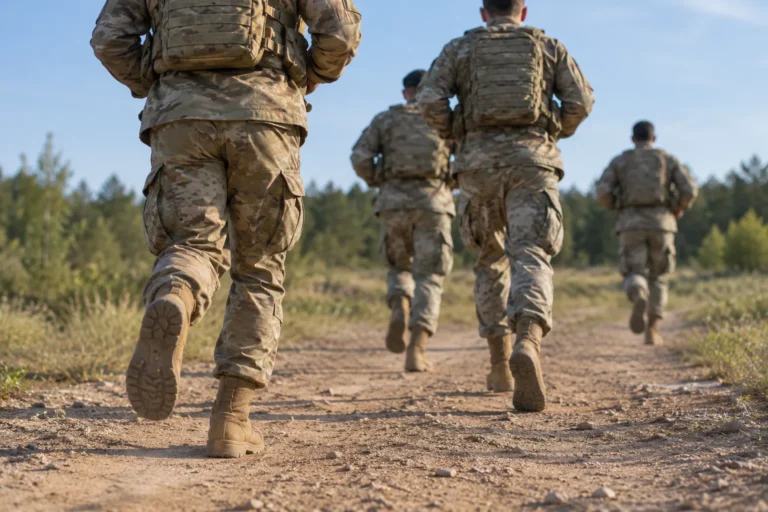
Saturday stays slow. Run easy for longer than two miles, at a pace where you can still talk. These easy miles build the engine your test run depends on.
Log every AFT workout in a notebook or app. Progressive overload only works when you can see last week’s numbers and beat them by a small margin.
How do I balance lifting and running?
Put heavy lifting and hard running on different days. When they must share a day, lift first and run second. Keep most of your runs easy and limit yourself to one hard interval session each week. Easy miles build your aerobic base without draining the legs you need for Monday’s deadlifts.
Sequence matters on a shared day. A hard run before deadlifts leaves your hips and lower back tired, and form breaks down under the bar. Lifting first keeps the heavy work safe. Your run will feel slower that day, and that is fine for easy miles.
Your baseline tells you where extra time should go. A slow run earns an extra easy run. A light deadlift earns an extra strength session. Your unit may already run its own army workout plan. Add your AFT prep only where it will not double your leg work.
Can I train for the AFT without a gym?
Yes. You can train four of the five events with bodyweight work, a backpack and open ground. The deadlift is the hard one, because no bodyweight move fully replaces a heavy hinge. Load a sturdy bag, do single-leg hinges, and get under a real bar a few times before test day.
Learning how to train for the AFT without a gym starts with a few swaps.
Event | Gym tool | No-gym swap |
|---|---|---|
Deadlift | Hex bar | Loaded backpack hinges, single-leg hinges |
Hand-release push-up | None needed | Same event, any flat floor |
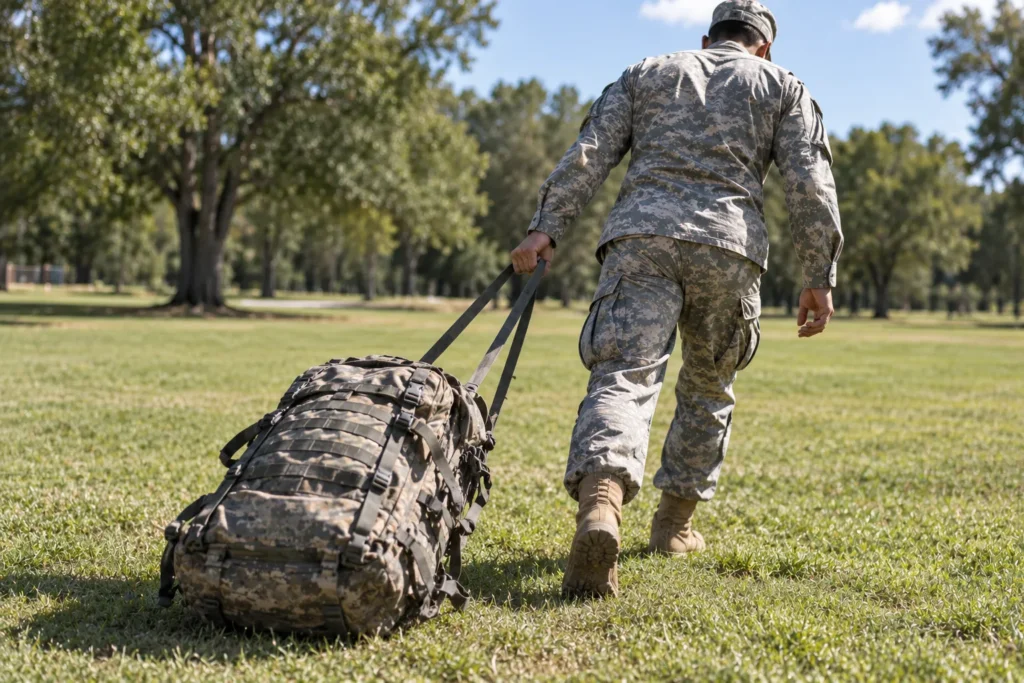
Sprint-drag-carry | Sled and kettlebells | Backpack or towel drags, water jug carries |
Plank | None needed | Same event |
Two-mile run | None needed | Measured road or track loop |
Event list: Army Directive 2025-06. Swaps are training substitutes, not test standards.
Test Week and Your Mock Score
Week 8 is short on purpose. Do two light sessions early in the week and one mock test no later than midweek. Rest for the final two days.
After the mock, plug your results in and compare them to your week 1 baseline. A practice number is only a guide to where you stand.
If you fail a record test, you retest within 90 days on active duty or AGR. Reserve Component Soldiers retest within 180 days.
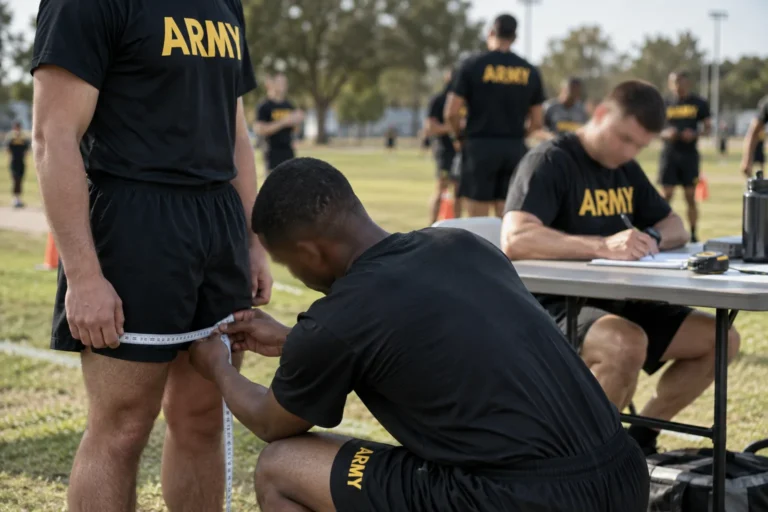
Your fitness record also covers body composition. Army Directive 2026-13, effective 7 July 2026, made a waist-to-height ratio under 0.550 the sole standard. Check your waist-to-height ratio in week 1 and again in week 8.
Frequently Asked Questions
Start Your Army PT Plan This Week
Run your baseline mock test this week and write down every event score. Start week 1 of this army pt plan on Monday. Retest yourself in week 8 and compare the two sets of numbers.