
OFFICIAL SCORING SCALES
AFT Score Chart
Every point value from 100 down to the 60-point floor, for all five events, across all ten age bands and both scoring columns.
This AFT score chart gives every point value from 100 down to the 60-point floor, for all five events, across all ten age bands and both scoring columns. Not just the 60, 80 and 100 rows.
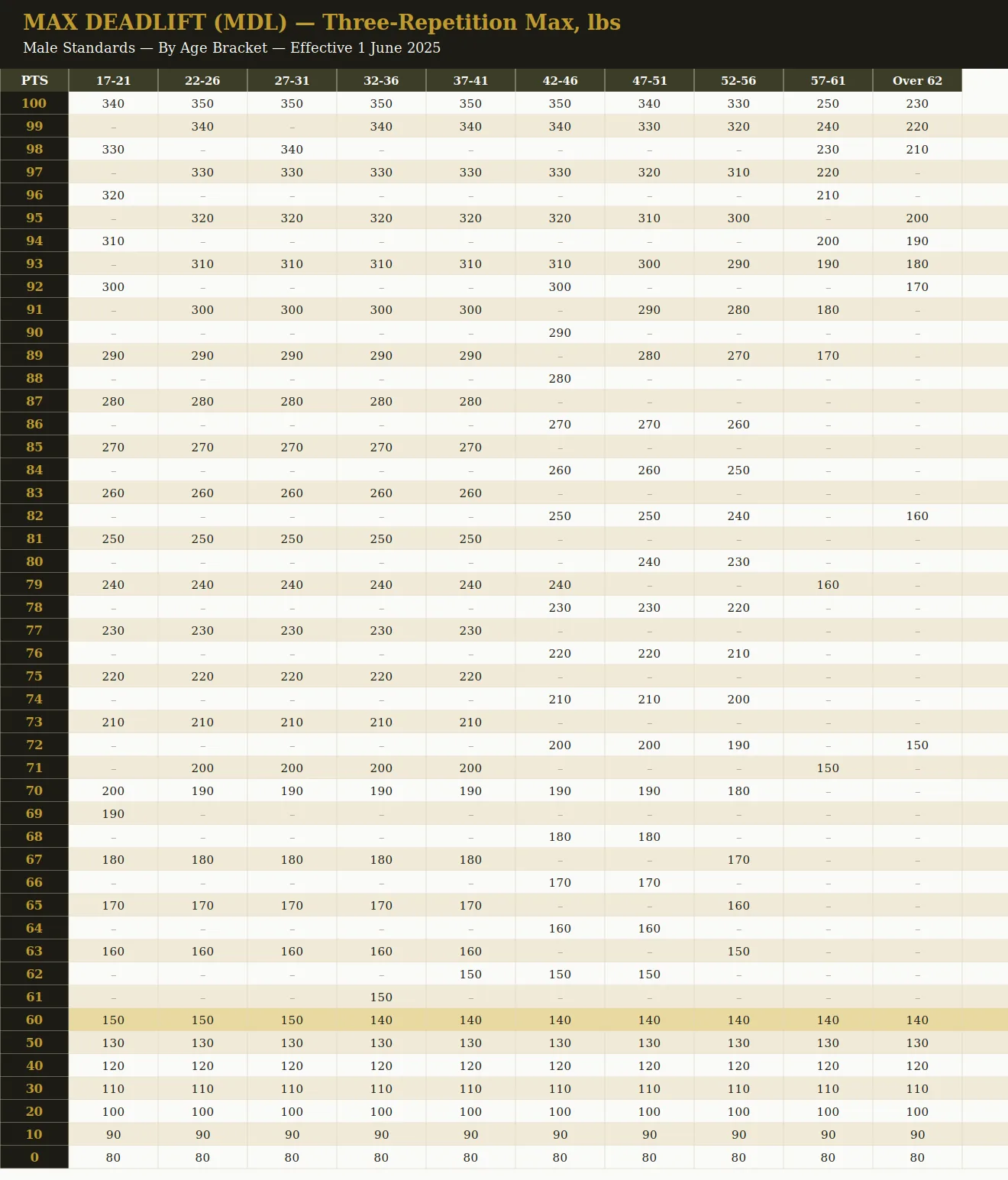
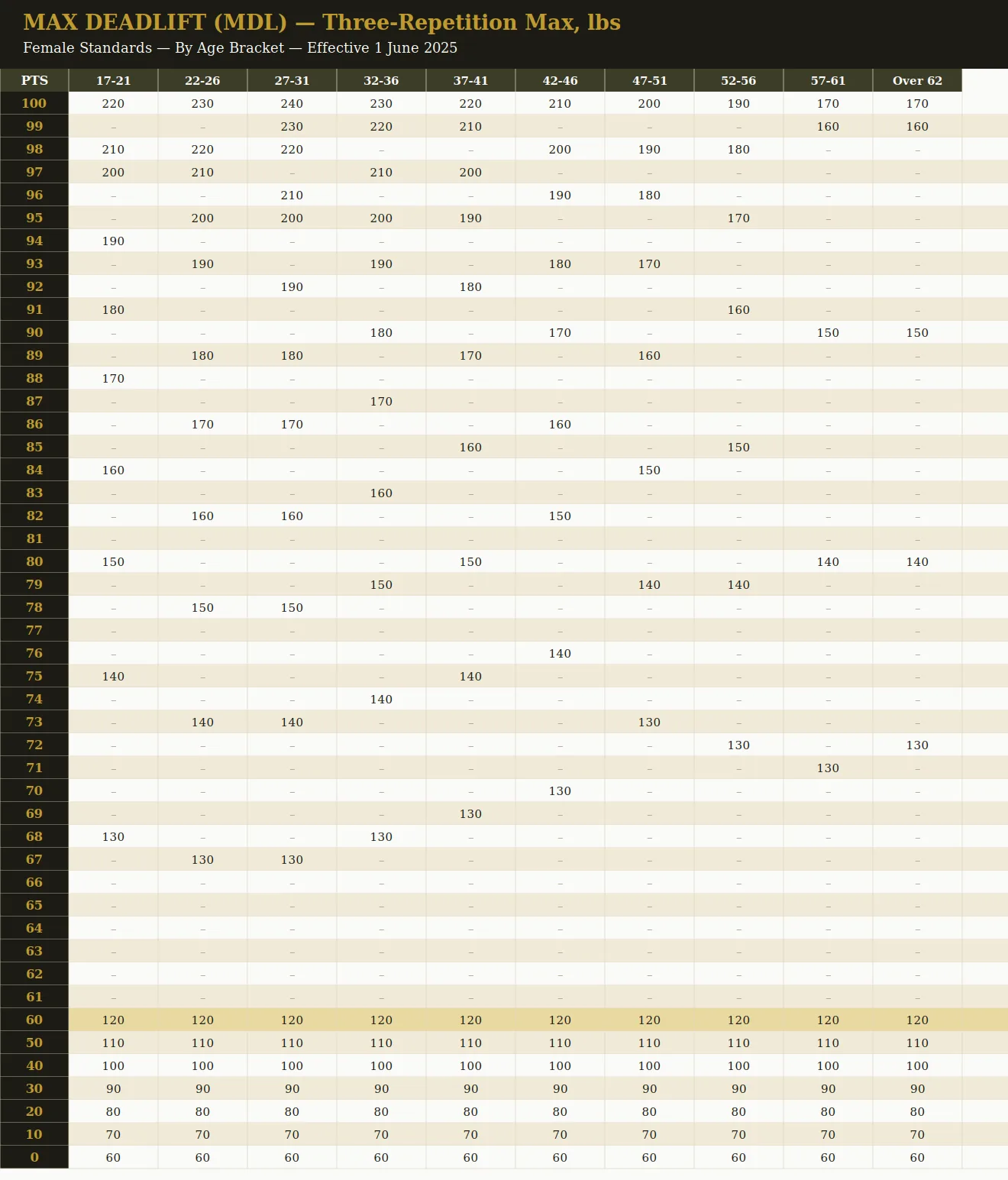
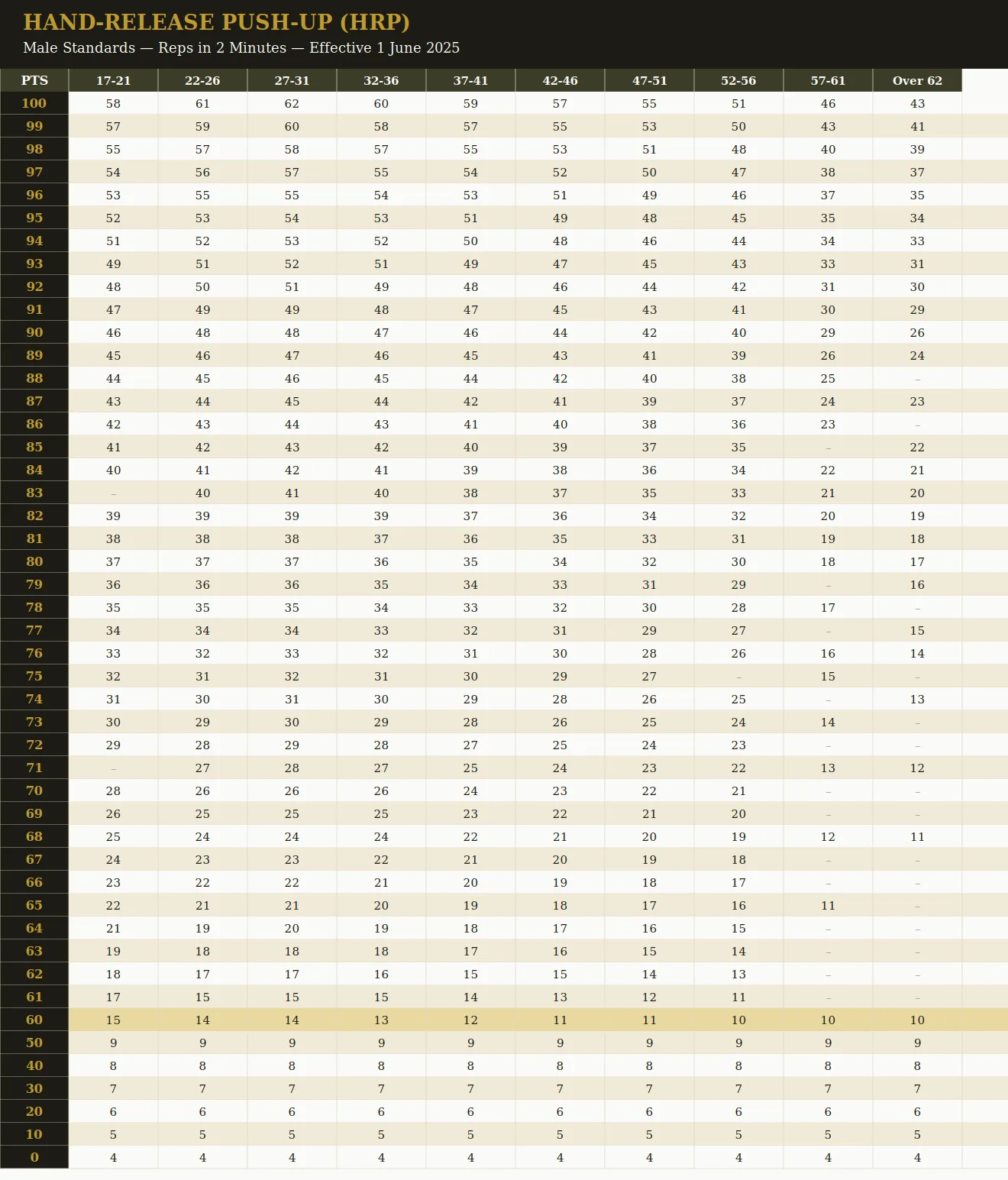
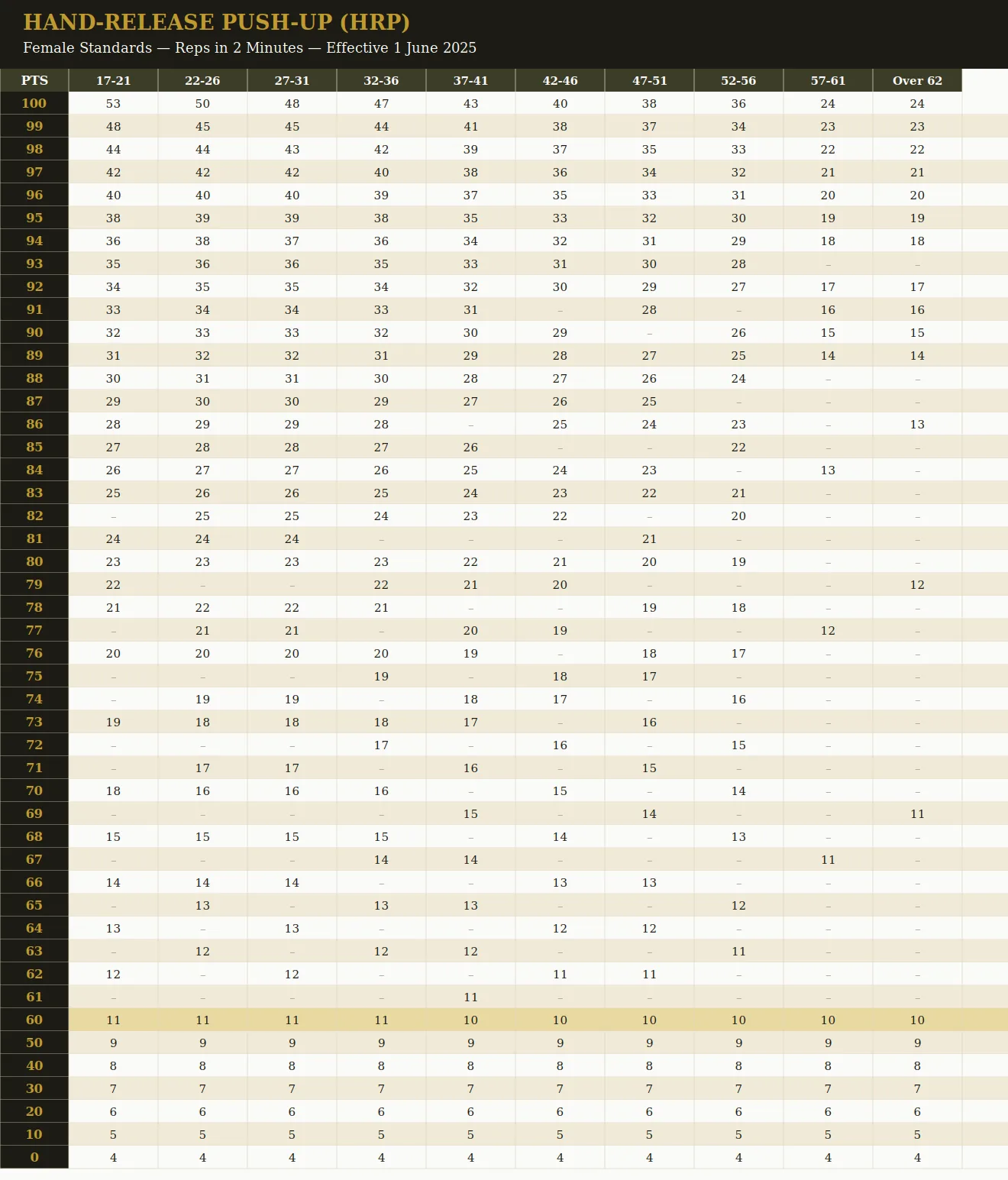
The charts below are taken from the Army Fitness Test scoring scales approved 15 May 2025. There is no formula behind them. Find your age band, find your column, find your raw number, read across. The 60-point floor is the row that decides whether you passed the event at all.
Looking for the ACFT score chart? The ACFT tables were only valid until 31 May 2025. These are the AFT tables in force since 1 June 2025. Combat MOS Soldiers are scored on the male column.
3-Rep Max Deadlift score chart
Heaviest weight lifted for three clean reps, in pounds.
Hand-Release Push-Up score chart
Correct repetitions completed in two minutes.
Sprint-Drag-Carry score chart
Five 50-metre shuttles. A lower time scores higher.
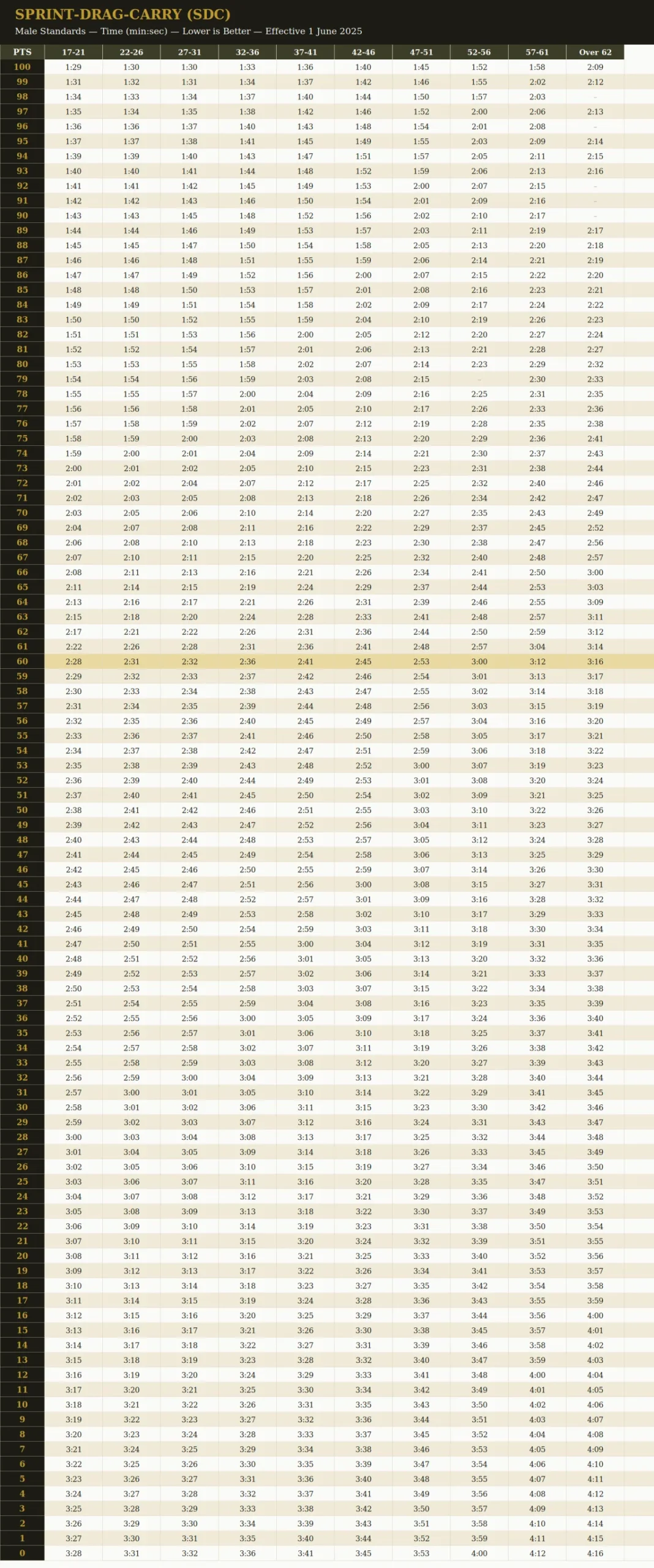
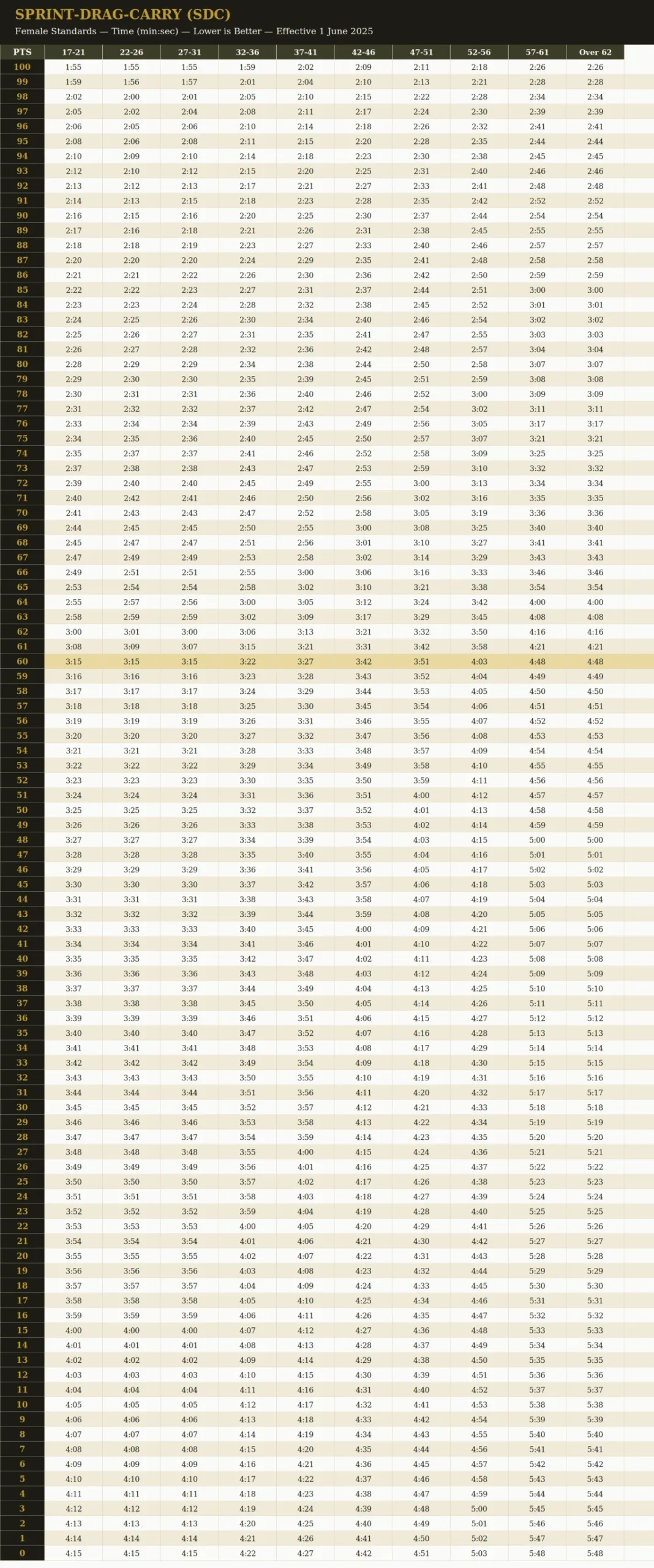
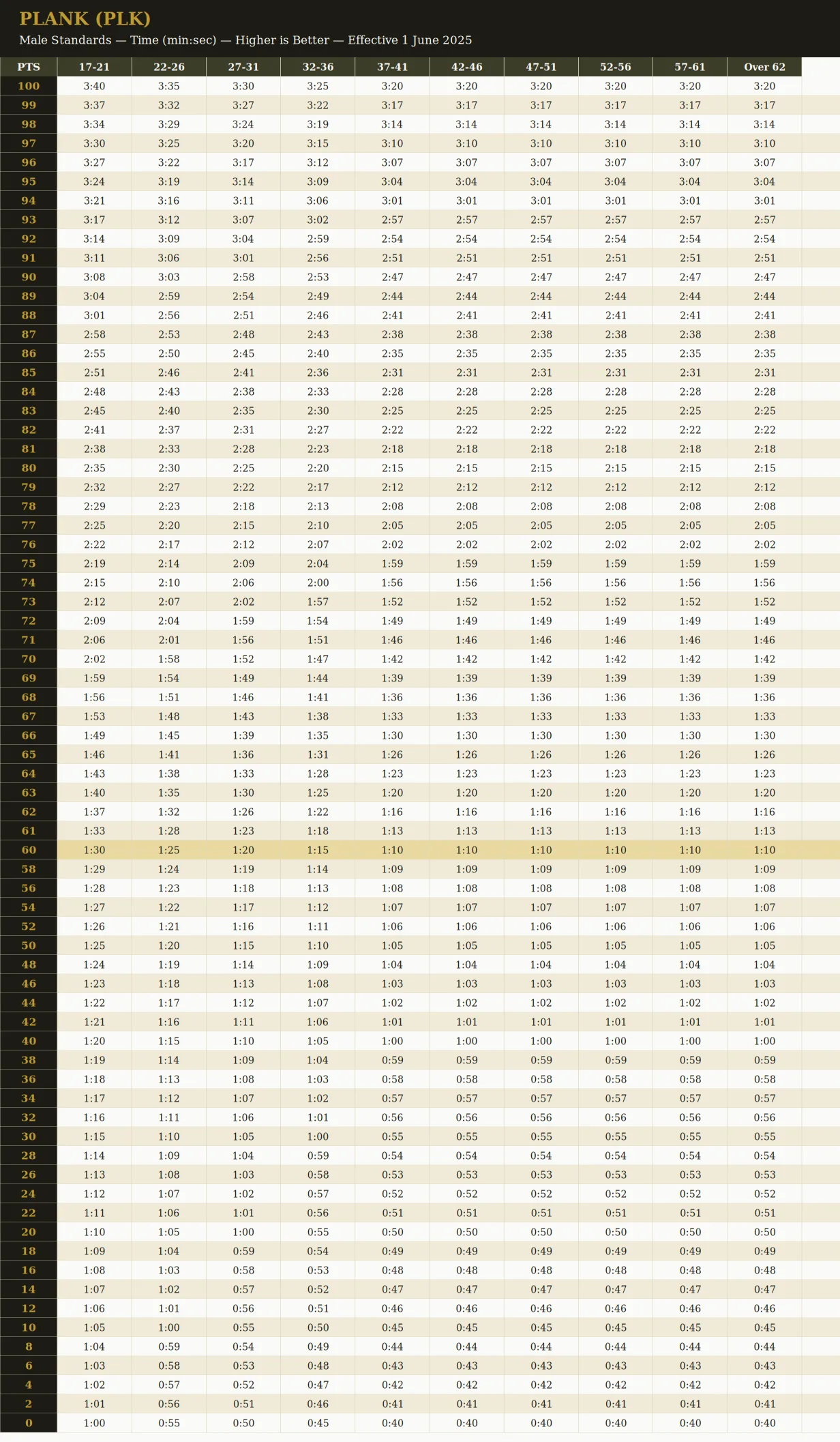
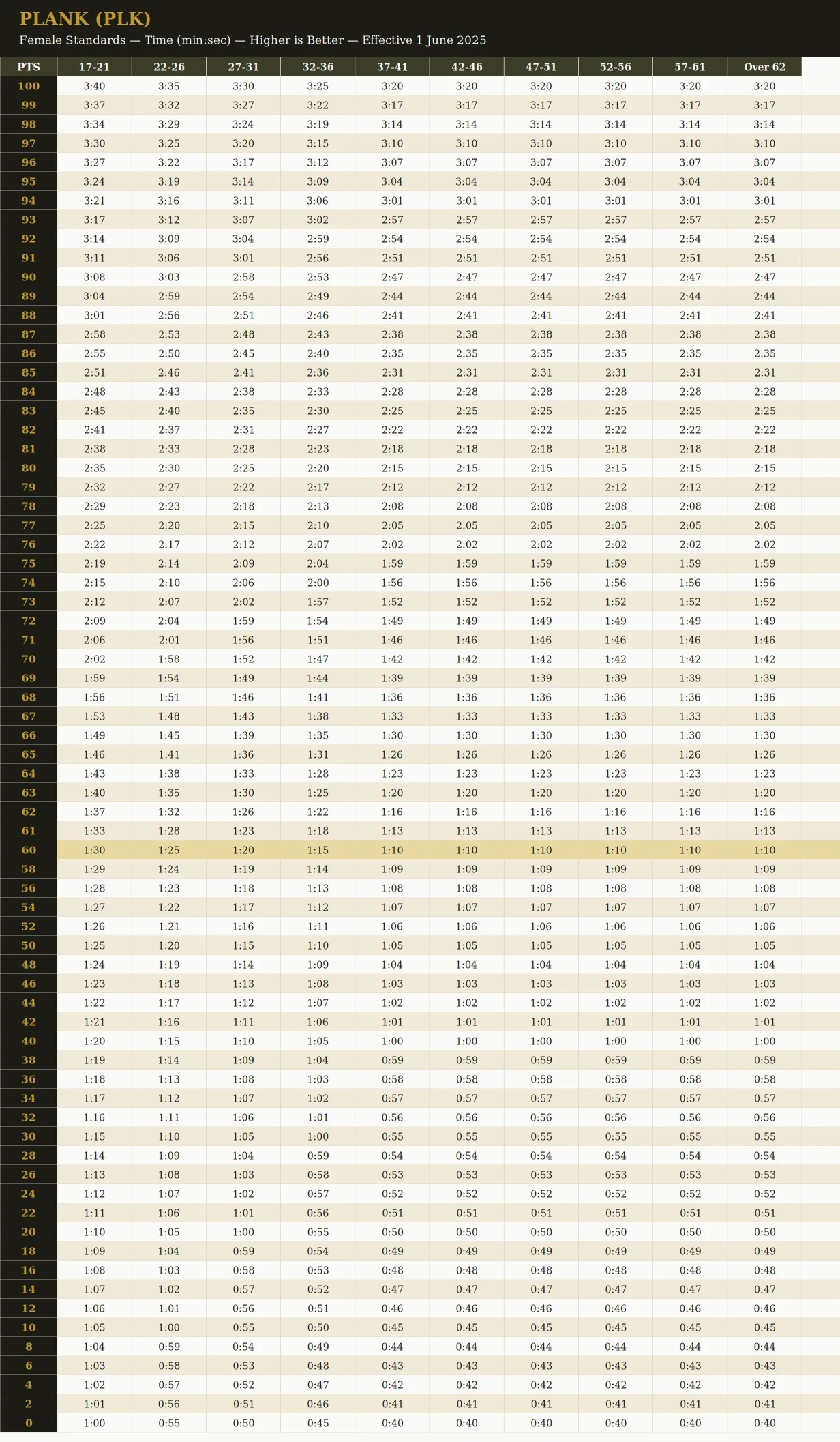
Plank score chart
Hold time. One scale for both men and women.
2-Mile Run score chart
Finish time on a flat measured course. A lower time scores higher.
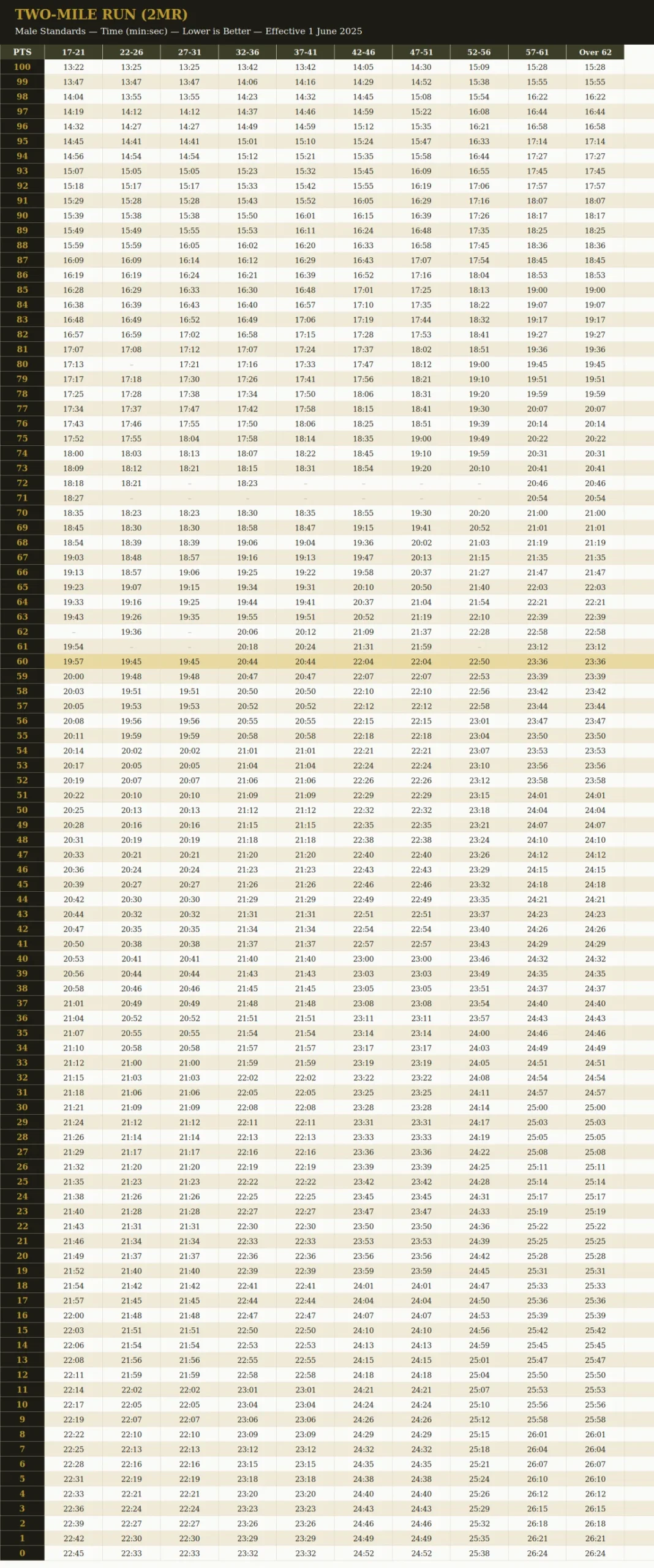
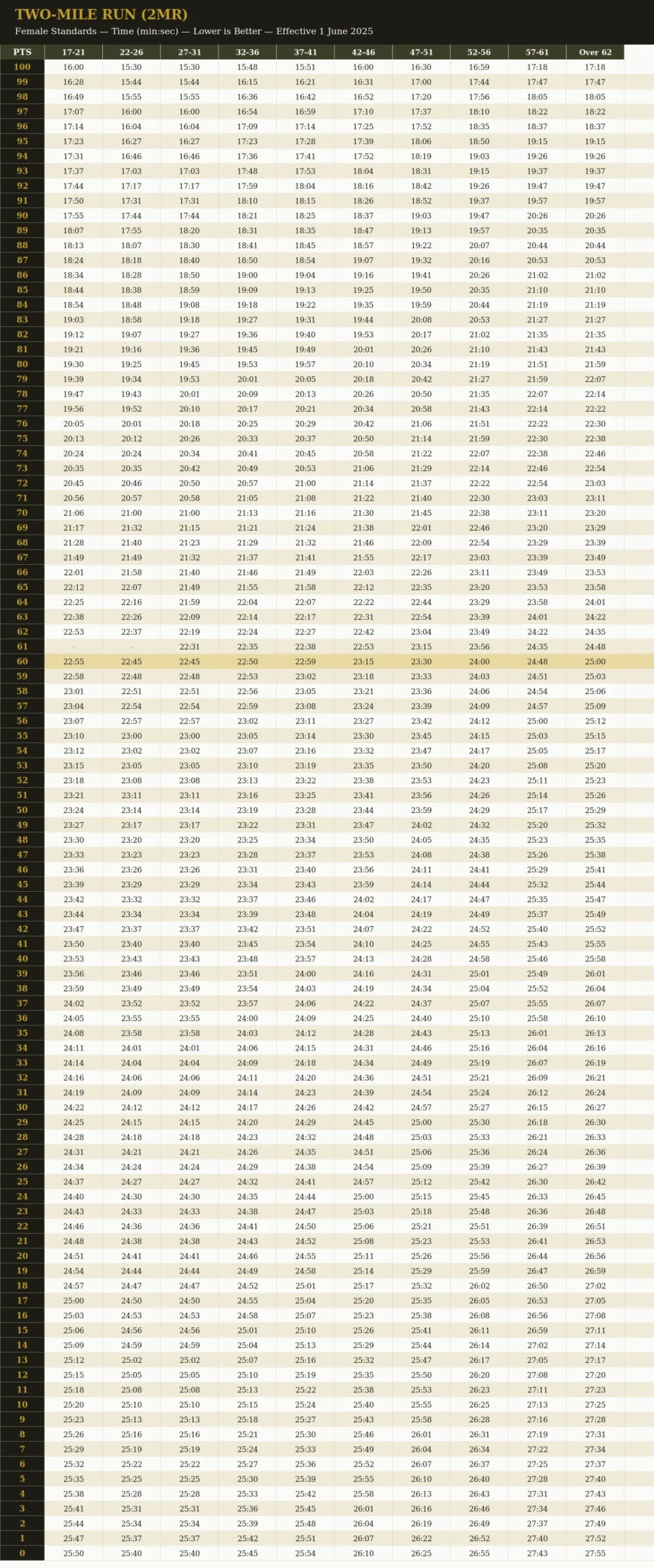
How to read the AFT scoring tables
Four things decide which number applies to you, and getting any one of them wrong gives you a score you did not earn.
Your age on test day. Ten bands, from 17-21 up to 62 and over. Not your age at the start of the year.
Your column. The general standard has separate male and female columns. The combat standard is sex-neutral, so everyone in a combat specialty reads the male column. It is not a third table, which is why the column above is headed Male / Combat.
Your raw result. Pounds for the deadlift, repetitions for push-ups, time for the other three.
The direction. Higher is better on deadlift, push-ups and plank. Lower is better on sprint-drag-carry and the two-mile run.
Every event is normed by age. The deadlift included. Some pages claim it uses one standard for everyone, and that will cost you. The plank is the only event where men and women read the same scale, which is why its tables show a single column.
Why some rows show a dash
The official scales do not increment at every point value for every event. Where the Army publishes no separate figure, the table shows a dash rather than an invented number. Read the nearest row above or below. A chart that fills those gaps with interpolated values is showing you scores that do not exist.
AFT score chart by age: what actually shifts
Older bands get more forgiving numbers for the same points, which is the whole purpose of age norming. The size of the shift is not uniform across events.
The two-mile run and the sprint-drag-carry move most between bands, because aerobic capacity declines with age more sharply than absolute strength. The deadlift moves least. A 45-year-old gets meaningfully more time on the run than a 25-year-old, but not much of a discount on the bar.
Two consequences worth planning around. If you are in an older band, the run is where the standards give you the most room, so it is rarely where you should spend training time. If you are 17 to 21, the run standards are the tightest you will ever face.
What the chart does not tell you
Whether you passed. Two rules decide that, and neither is on the chart. You need 60 points on every event, and you need your total: 300 under the general standard, 350 for a combat specialty. A 340 total with a 58 on the run is a failure.
Which specialties are combat. Twenty-four, listed in enclosure 2 of Army Directive 2026-07. Many pages still say 21. That figure was correct until 17 April 2026, when Army Diver, EOD Specialist and EOD Officer were added.
Your body composition status. That is a separate measurement now, and nothing on this chart affects it. The 465-point exemption was rescinded on 7 July 2026, so a high score no longer exempts anyone from the waist-to-height standard.
Your promotion points. A different conversion, a different regulation, and not this table.
How these tables are built
Every figure on this page comes from a single official data file, the same one the calculator scores from. Nothing here is typed by hand or copied from another site.
That matters for a boring reason. Hand-typed tables drift. Correct one number on one page and the other twenty-nine keep the old value. When we correct a scale here, the chart and the calculator both change at once, so the two can never disagree.
When we get something wrong, it goes in the changelog with a date.
Frequently Asked Questions
Before test day
Find your row a week out, not the morning of. Write down the raw number you need for 60 on each event and the number you need for the total you are chasing. Then run the calculator to see which event is your cheapest next point. Most soldiers train the event they enjoy rather than the one closest to the line.