EVENT TRAINING
Army Plank: Hold Times by Age and What Ends Your Test
You pass the army plank at 1:30 if you are 17 to 21. From age 37 up, the line is 1:10. Max points need 3:40 down to 3:20. A hand or foot off the floor ends it.
One column, not two. The PLK is a sex-neutral event. Men and women read identical numbers in all ten age bands. Your combat or non-combat status does not change the plank either.
Typing plank army standards into a search bar still pulls up pages built for the retired six-event test. The Army Fitness Test replaced the ACFT on 1 June 2025 under Army Directive 2025-06. The plank test carried over. Its scoring scales were reissued, approved 15 May 2025 and effective 1 June 2025.
AFT Plank Hold Times by Age Band
The aft plank is scored on time held, not on repetitions. Every aft plank result reads off the single table below.
Maximum points land at 3:40 for ages 17 to 21. The plank time for 100 points AFT scoring recognizes drops to 3:20 from age 37 up. After the 37 to 41 bracket the scale stops moving. A 39-year-old and a 63-year-old hold to the same numbers.
Army plank standards by age, all ten brackets, in minutes and seconds:
Age band | 60 pts (pass) | 70 pts | 80 pts | 90 pts | 100 pts (max) |
|---|---|---|---|---|---|
17 to 21 | 1:30 | 2:02 | 2:35 | 3:08 | 3:40 |
22 to 26 | 1:25 | 1:58 | 2:30 | 3:03 | 3:35 |
27 to 31 | 1:20 | 1:52 | 2:25 | 2:58 | 3:30 |
32 to 36 | 1:15 | 1:47 | 2:20 | 2:53 | 3:25 |
37 to 41 | 1:10 | 1:42 | 2:15 | 2:47 | 3:20 |
42 to 46 | 1:10 | 1:42 | 2:15 | 2:47 | 3:20 |
47 to 51 | 1:10 | 1:42 | 2:15 | 2:47 | 3:20 |
52 to 56 | 1:10 | 1:42 | 2:15 | 2:47 | 3:20 |
57 to 61 | 1:10 | 1:42 | 2:15 | 2:47 | 3:20 |
Over 62 | 1:10 | 1:42 | 2:15 | 2:47 | 3:20 |
Source: Official AFT Scoring Scales, approved 15 May 2025, effective 1 June 2025.
Your time takes the point value of the highest line you have passed. The table does not interpolate between rows. Hold 2:30 in the 17 to 21 band and you take the nearest lower printed line. You do not get a fraction above it. Round down and plan your target a few seconds clear of the line.
Some sites still tell soldiers the army plank has no minimum hold time. That is half right and half wrong. There is no upper cap, and the clock runs until you break or quit. There is also a hard floor, and it is the 60-point line for your age band. Miss it and you fail the whole AFT, whatever your other four scores say. You can check the margin on every event before test day.
Your age on test day sets your column. Turn 22 the week before, and you read the 22 to 26 row.
Plank Standards Move in Different Steps Above and Below 60 Points
The army plank standards are not a smooth ramp. The table changes gear at the 60-point line, and almost nobody mentions it.
Above 60, roughly three seconds buys one point. For a 20-year-old, 1:30 scores 60 and 3:40 scores 100. That is 130 extra seconds for 40 points.
Below 60, the scale only prints even numbers. There is no 59, no 57, no 55. Every single second you fall short costs two points, not one. A 20-year-old holding 1:29 scores 58. At 1:25 the score is 50.
The floor is absolute. A 17 to 21 soldier who holds 1:00 scores zero on the event. From 37 up, zero starts at 0:40. Those figures come from the same scoring scales. You can read every scoring line by age band alongside the other four events.
Does a Combat MOS Change the Plank?
No. The combat standard is sex-neutral and age-normed, and it reads the male column. On the plank, the male and female columns already carry identical times. Swapping columns changes nothing on this event.
What does change is the total. Combat MOS soldiers need 350 points across the five events. Everyone else needs 300. Both groups still need 60 on the plank itself.
What Ends the Plank Event on the AFT?
Two lists decide what ends the plank event AFT graders score. One list gets you a warning. The other stops the clock on the spot.
The event ends if you touch the ground with anything other than feet, forearms, or fists and palms. Raising a foot or a hand off the floor ends it. Losing the straight line from head to heels ends it too.
Graders give one verbal warning for a position failure. The same warning covers hands or feet sliding out of place. Fix it and hold, and the clock keeps running. Fail to fix it, and your performance is terminated.
That is the one warning rule, and it saves points. A grader correction is not a failure. Soldiers quit on the first call because they assume the event is over. It is not.
What happens | Warning first? | Result |
|---|---|---|
Hips sag or pike out of the straight line | Yes, one verbal warning | Ends only if you cannot correct |
Hands or feet slide from position | Yes, one verbal warning | Ends only if you cannot correct |
Knee, thigh, or chest touches the ground | No | Ends immediately |
A hand or a foot lifts off the floor | No | Ends immediately |
Shaking or trembling from max exertion | Not a fault | The hold continues |
Source: army.mil AFT event standards, PLK.
Shaking is written into the standard as allowed. Trembling under maximum exertion is permitted, provided you hold the position.
A failed event sinks the whole test, because the 60-point floor sits on all five events. Check yours against the published tables for every event before you test.
What Counts as Sagging Hips?
Sagging hips means your hips have dropped below the straight line running from your head to your heels. The Army does not publish a degree measurement. Your grader judges the line by eye and gives you one verbal warning. The event ends if you cannot bring the hips back up.
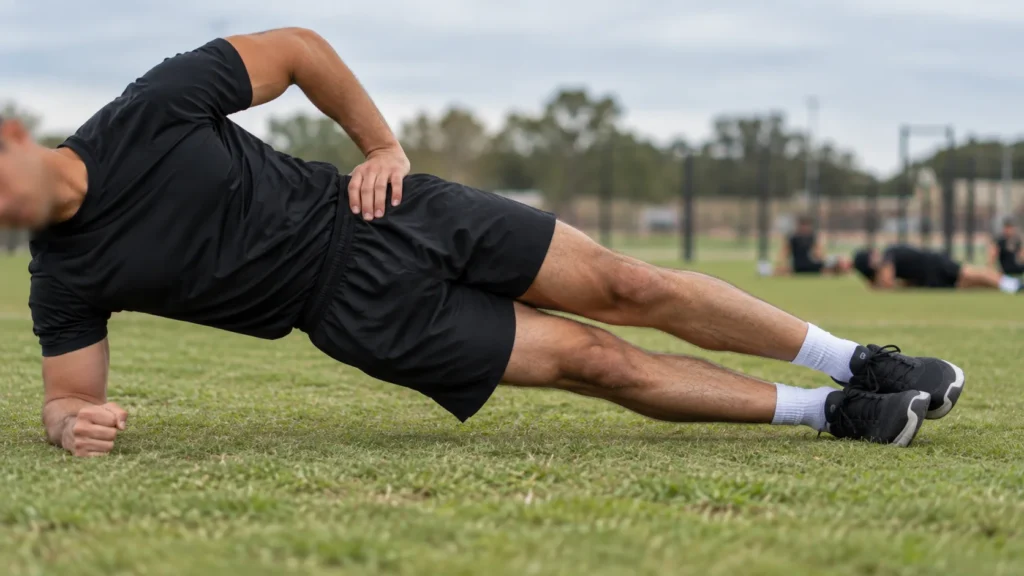
Piking counts too. Hips riding high breaks the same straight line as hips riding low. Both draw the same single warning.
What Does the Plank Measure?
Muscular endurance, with balance as a secondary component. The Army links the event to surmounting obstacles and walls, and to rope climbing, descending, and traversing. Core endurance is what holds your trunk rigid while your arms and legs do the work.
How to Hold a Plank Longer for the AFT
Set up correctly before the clock starts. On GET READY your hands go down as fists with the pinky side touching, or flat with palms down. They sit no more than a grader fist-width apart. Elbows sit under the shoulders. Forearms lie flat and form a triangle.
Three commands run this event. GET READY builds the base with one or both knees still down. GET SET lifts both knees and brings the hips into line with the legs, shoulders, and head. Eyes go to the ground. GO starts the clock.
Your fingers may not interlock, interlace, or touch across hands. Feet can sit up to a boot-width apart. Ankles stay flexed with the bottom of the toes on the ground.
The forearm plank is an isometric hold, so nothing moves and nothing rests. Squeeze the glutes and the quads. That tension is what keeps the hips in line when the core starts to fade, and it is legal.
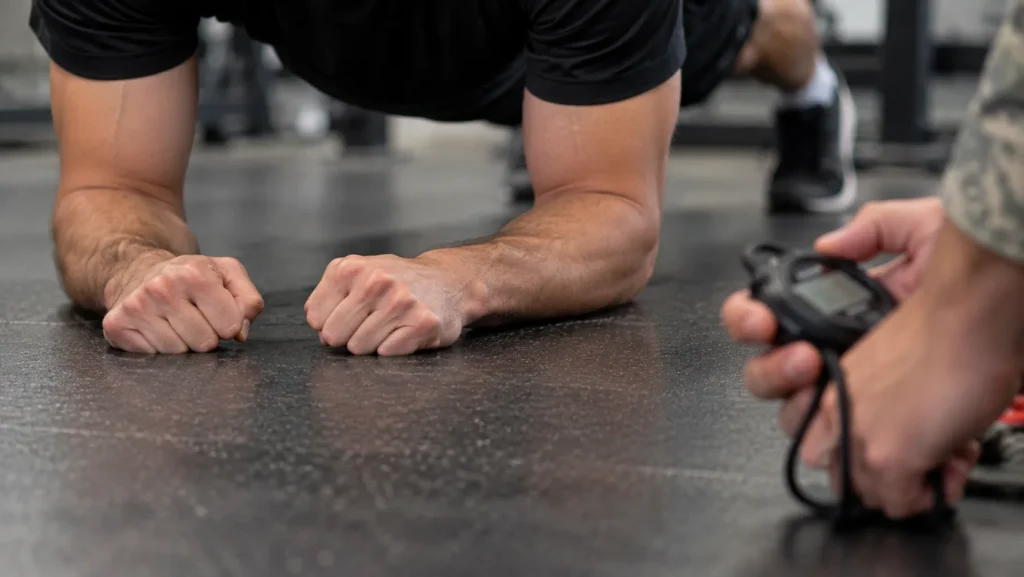
Train the position, not just the duration. Short holds done often beat one long weekly attempt. The event needs no equipment at all. A level surface is the whole kit list, so you can rehearse it in a barracks room or a hotel room on leave.
Breathe slow and steady through the hold. Soldiers who hold their breath fail early on carbon dioxide, not on core strength.
Eyes down. Looking up pulls the head out of line and starts the clock on your warning.
The last 30 seconds decide most scores. Shorten your breathing cycle and keep the glutes locked. Do not buy time by lifting the hips, because piking is the fault graders call first.
Which Drills Does the Army List for the Plank?
Three, and they are named on the official event page. The bent-leg raise, the leg tuck and twist, and the side bridge.
Each one loads the trunk under tension without chasing repetition speed. Work them into your normal PT week rather than saving them for the fortnight before a record test.
Should You Train Past 3:40?
No, for scoring purposes. Points stop at 3:40 in the youngest band and at 3:20 from 37 up. Holding four minutes earns the same 100 as holding 3:40.
Train past the max for margin, not for points. If your best is 3:45 in the gym, a bad test day still lands you on 100. Those points carry into your total, which feeds promotion standing.
What Happens If You Miss the Standard
Scoring under 60 on the aft plank fails the whole AFT. The other four cannot carry it. A 350 total with a 55 on the plank is still a failure.
Retesting runs on a clock. Active-duty soldiers, Active Guard Reserve, and Reserve soldiers on orders longer than 60 days retest within 90 days. National Guard and Reserve soldiers retest within 180 days.
Use that window properly. Short daily holds fit around duty far more easily than a full lift or run session, so this is the event you can move fastest on.
Frequently Asked Questions
What to Do Next
Find your age band in the table above, then time yourself cold on a level surface. Compare it to your 60, 80, and 100-point lines. You will know how many seconds you owe. The army plank rewards a clean position more than raw grit, so drill the setup until the straight line holds itself. Turn your practice hold into points and check it against the other four events before test day.
One last thing. Only a certified grader entering your result into DTMS produces an official score. Practice times are training data, nothing more.