BODY COMPOSITION
Army ABCP: What Happens if You Fail the WHtR Standard
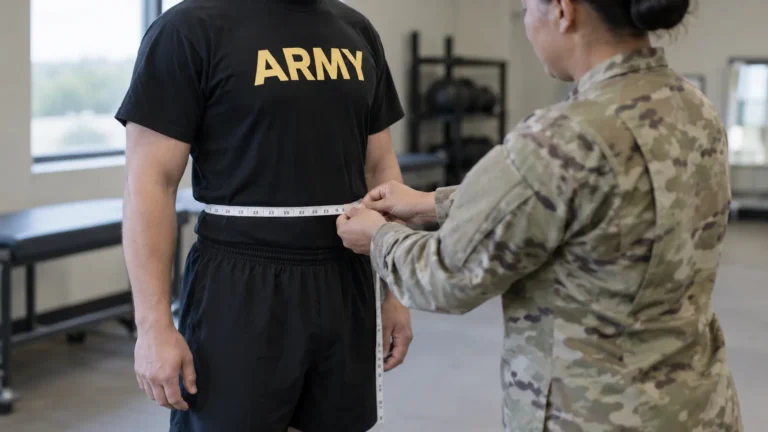
Fail the WHtR screening and you are not in the ABCP yet. A different team re-measures you the same duty day. Only a confirmed reading of 0.55 or higher brings a flag and enrollment. The first number is a screening, not a verdict.
Army Directive 2026-13 took effect on 7 July 2026. It made waist-to-height ratio the only authorized measurement for body composition. Army leaders may no longer use height and weight tables. The tape test is gone too.
One line inside that directive shapes more outcomes than any other. It sets a seven-day gap between your fitness test and your screening. Almost no site covers it.
Seven Days Between the AFT and Your WHtR: The Army ABCP Rule Most Guides Skip
Paragraph 5a(6) of Army Directive 2026-13 is two sentences long. Commanders and supervisors must allow a minimum of seven days between the AFT or CFT and the WHtR screening. That line is the strongest Army ABCP safeguard most soldiers never hear about.
Read the reason the directive gives. The gap exists so the screening does not interfere with your test performance. That covers both the AFT and the CFT. The directive states that purpose and stops there. It offers no further explanation, so do not trust any site that invents one.
The rule has a release valve. Paragraph 5a(6) also lets commanders deviate to meet urgent operational needs. A unit heading to the field can compress the schedule legally.
That same floor appears in the official program FAQ, in plain words. Units must allow at least seven days, and commanders may modify that when operational demands require it. Two documents, one rule.
How long after the AFT can they measure you?
Seven days is the floor, not the target. If your record test lands on a Tuesday, the earliest compliant screening is the following Tuesday. Nothing in the directive caps the other end, so a unit can screen you months later.
Ask your training NCO for both dates as soon as the calendar posts. Count the days yourself. Calendars slip, and the screening often gets tacked onto a training holiday week.
Write both dates down when you get them. A short note in your own calendar gives you something concrete to raise at the next formation. Memory does not hold up well against a published training schedule.
What if the screening falls inside the window?
Raise it before the measurement, not after. Paragraph 5a(6) directs commanders and supervisors to allow the gap. It is a leader decision, not a soldier entitlement.
The directive lists no remedy for a reading taken inside seven days. There is no appeal paragraph and no voiding clause. Once the number is recorded, your argument about timing has nowhere to go.
So the fix is a conversation with your first-line leader during scheduling. Bring the paragraph number. Leaders respond to a citation faster than an opinion.
Before either date arrives, check your waist against your height so the result is never a surprise. You can also work through your five scored events to see where your test sits.
What the First Failed Screening Actually Triggers
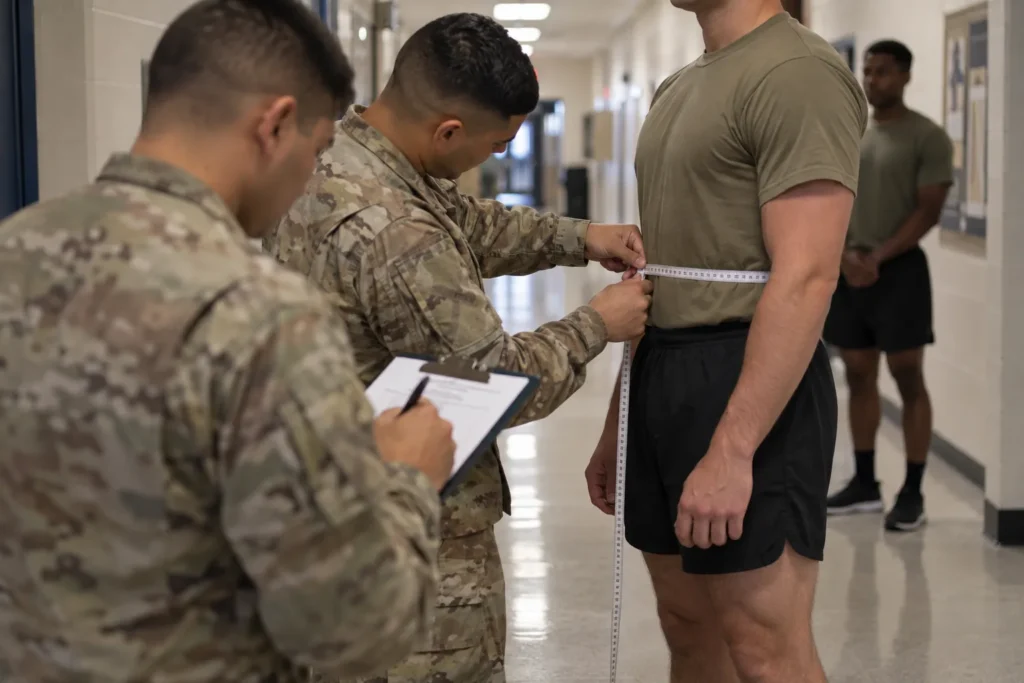
Nothing administrative happens on the strength of one measurement. Paragraph 5a(4) requires a confirmation measurement on the same duty day. A team other than the one that took the first set must conduct it.
The directive is direct about sequence. That second measurement must happen before the commander takes any action.
That wording puts the burden on the unit, not on you. You do not file anything, appeal anything, or ask for the re-check. Screening teams that skip it are running the program wrong, and paragraph 5a(4) is the line to point at.
What happens if you fail the WHtR?
You get measured again the same duty day by a different team. A second reading of 0.55 or greater brings a flag and enrollment under paragraph 5a(5). If the second reading clears the standard, you carry on with no flag and no enrollment.
The standard itself is exact. The directive sets it at “less than and not equal to 0.55.”
What is a confirmation measurement, exactly?
It is a full re-measure, not a second opinion on the first tape. Waist goes at the navel in inches, divided by height in inches.
The Army records the ratio to three decimal places and drops everything after the third. There is no rounding. A 0.549 passes. A 0.550 fails.
That precision cuts both ways, so do the arithmetic before someone does it to you. Multiply your height in inches by 0.55. A soldier who is 70 inches tall needs a waist under 38.5 inches. At exactly 38.5 the ratio reads 0.550, which is a failure by one thousandth. Run your own measurement first and you will know which side of that line you sit on.
Detail | Initial measurement | Confirmation measurement |
|---|---|---|
Who takes it | The scheduled screening team | A team other than the first one |
When | The screening date | The same duty day |
Required before command action | No | Yes, per paragraph 5a(4) |
Can trigger a flag alone | No | Yes, at 0.55 or greater |
Recorded where | DA Form 5500 and ATIS | DA Form 5500 and ATIS |
Two failed readings on the same duty day is the trigger. One failed reading is paperwork in progress.
Flag Code K and What It Shuts Off
A confirmed failure puts you under flag code K, noncompliance with the Army Body Composition Program. Army Directive 2026-13 amended Army Regulation 600-8-2 to rescind all transfer provisions for that flag. The ABCP flag does not move with you.
That matters more than it sounds. You cannot outrun the flag by changing units, and a gaining unit inherits nothing that clears it.
General flagging instructions in paragraph 2-2 of Army Regulation 600-8-2 still apply. A flag suspends favorable personnel actions while it is active. For the practical list of what stops, read our breakdown of what a suspension of favorable actions blocks.
Commanders now own the program directly. Paragraph 5b(1) rescinded the requirement to appoint an NCO to run it. Quality control and execution sit with the commander, which means your chain of command is the whole appeal chain.
That cuts out a middle layer. There is no program administrator to chase for a reassessment date or a corrected entry. Take both to your first-line leader and let the chain carry it to the commander.
Does a medical exam follow enrollment?
It depends on your component. For Regular Army and Active Guard Reserve soldiers, paragraph 5b(4) has the commander request a medical examination. The exam checks whether an underlying medical condition is the direct cause.
Army National Guard and Army Reserve soldiers sit under paragraph 5b(5). They may request an exam, and soldiers not on active duty pay for it themselves. Ask for it early if you have a documented condition.
Getting Removed From the Program
This is the part of Army Directive 2026-13 that helps enrolled soldiers most. Paragraph 5b(6) rescinded progression requirements and mandatory monthly assessments.
You come off the ABCP as soon as you meet the standard. Commanders and supervisors decide when to reassess you.
Read that as a trade. The monthly weigh-in is gone, but so is the guaranteed monthly chance to prove you have fixed it. Ask your leader to schedule a reassessment once your own numbers clear the line.
Enrollment, disenrollment, counseling and administrative actions still run under Army Regulation 600-9. That regulation stays in force until the Army rewrites it. Paragraph 6 sets a two-year deadline for the rewrite.
Army Directive 2026-13 also controls where it conflicts with older rules, per paragraph 5. It is not retroactive. A screening from the old system does not follow you into the new one. AD 2025-17 and what replaced it works the same way.
Who the Standard Covers
Every soldier in the Regular Army, Army National Guard and Army Reserve falls under paragraph 3. There is no component carve-out.
Paragraph 5 reaches further than most readers expect. It covers cadets at the United States Military Academy and Senior ROTC cadets. It covers all retention actions. It covers military schools and institutional training courses.
School attendance is where soldiers get caught out. A ratio of 0.55 or higher can stop a course seat even when nothing else in your file is wrong. Check the graduation requirements for any course you are slated for.
Pregnancy and postpartum status are handled separately. Existing medical exemptions to body composition standards stay in effect, per the official program FAQ. Nothing in Army Directive 2026-13 removed them.
The directive also carries an end date of its own. Paragraph 7 rescinds it once the revised regulations publish. Expect these rules to move into Army Regulation 600-9 within two years.
How Often Are You Measured for WHtR?
At least twice per calendar year, under paragraph 5a(2). That is the floor for every soldier the directive covers.
Paragraph 5a(10) adds a second route. A commander may direct a screening at any time if they believe you do not meet the standard. There is no notice requirement attached.
Recording runs through two places. Paragraph 5a(8) puts the ratio on DA Form 5500 and in the Army Training Information System, known as ATIS. DA Form 5501 is rescinded. Leaders enter the result in ATIS using the Leader Tool.
A 90-day deadline applied at rollout under paragraph 5a(9). Every soldier needed a screening recorded in ATIS within 90 days of the directive date. That window has closed, so your unit most likely has a number on file for you. Ask to see it. Your own tracking does not replace the official entry, because only a recorded screening counts.
Can You Request a Tape Test? Army Policy Says No
Army Directive 2026-13 bars every secondary and supplemental method at paragraph 5a(1). The circumference-based tape test is named there. The old Army body fat assessment methods are rescinded, not held in reserve.
Item | Before 7 July 2026 | Under Army Directive 2026-13 |
|---|---|---|
Screening method | Height and weight tables | Waist divided by height |
Backup assessment | Circumference tape test | None authorized |
High-score exemption | 465 on the AFT | Rescinded |
Progress checks while enrolled | Monthly | When the commander decides |
Recording form | DA Form 5500 and DA Form 5501 | DA Form 5500 only |
Your only challenge route is the confirmation measurement on the same duty day.
Paragraph 5a(7) closes the other door people ask about. No AFT score exempts you from the standard, and the directive rescinded AD 2025-17 outright. We covered the policy that ended the high-score exemption in full.
Separation Actions Are on Hold
Units may initiate separation actions against a soldier flagged for failing the program. Paragraph 5b(8) then applies the brake. It bars actual separation until HQDA finishes its review and publishes further guidance.
The 180-day HQDA assessment reviews the accuracy, fairness and readiness impact of the standard. It may bring refinements. Nothing published so far says what those would be.
Treat that as a pause, not a pardon. The flag is live, the counseling is real, and the separation packet can still be built while the review runs. How a flag lands on your record matters just as much as what happens at the end of it.
Frequently Asked Questions
What to Do Next
Find two dates: your next fitness test and your next screening. Count the days between them, because paragraph 5a(6) gives you seven. If the gap is short, raise it with your first-line leader while the calendar is still a draft.
Then get the number yourself. Measure at the navel, divide by your height in inches, and read it to three decimals. Track that ratio monthly and the ABCP stops being a surprise. You will not need a confirmation measurement to learn where you stand.
Verify anything here against Army Directive 2026-13 itself before you brief it to anyone.