PROMOTIONS
Army Promotion Points: The Full 800-Point Breakdown
Every category, every cap, and the source in AR 600-8-19. Verified against the 6 March 2026 edition.
Army promotion points top out at 800 for both sergeant and staff sergeant. Four categories build that total: military training, awards, military education, and civilian education. The caps inside those four army promotion points categories are different for E-5 and E-6.
That difference is where most soldiers lose ground. A record that scores well for sergeant does not automatically score well for staff sergeant. Below is every category, every cap, and the source in Army Regulation 600-8-19.
What Your Army PPW Counts Toward 800 Points
Your Army PPW is the worksheet that holds all of it. The Army PPW lives in the Integrated Personnel and Pay System-Army, called IPPS-A. It pulls from your official records, not from anything you type in.
Army Regulation 600-8-19, dated 6 March 2026 and effective 6 April 2026, sets the categories. It carries the title Enlisted Promotions and Demotions. This edition replaced the 21 June 2024 version. It also folded in Army Directive 2025-06, which brought the Army Fitness Test into the promotion system.
Here is how the 800 splits by rank.
Category | Cap for SGT (E-5) | Cap for SSG (E-6) |
|---|---|---|
Military training (weapons qualification and fitness) | 280 | 230 |
Awards, decorations, and achievements | 145 | 165 |
Military education | 240 | 245 |
Civilian education | 135 | 160 |
Total | 800 | 800 |
Both columns add to exactly 800. Nothing is left over and nothing is hidden.
Read the table sideways and the Army’s logic shows up. A specialist competing for sergeant earns more from the range and the gym. A sergeant competing for staff sergeant earns more from schools, awards, and college credit. The Army expects your record to mature as you move up.
That shift catches people mid-career. A specialist who built a strong file on physical performance keeps those army promotion points at E-6. The ceiling above them drops by 50. The 45 points that moved into awards and civilian education have to come from somewhere else, and both take months to earn.
How to Read Your Promotion Point Worksheet
Your promotion point worksheet shows a running subtotal for each of the four categories. Compare each subtotal against the cap for the rank you are competing for, not the rank you hold. A sergeant looking at a promotion point worksheet is competing against the E-6 column.
Then find your smallest gap. Say you sit 90 points under the military education cap and 5 under the civilian education cap. School hours are worth chasing. One more college class is not.
Promotion Points for Common Badges, Awards and Schools
The items soldiers ask about most, with the points each one pays. Full rules for every category are in the sections below.
Item | Points |
|---|---|
Expert Infantryman, Expert Soldier or Expert Field Medical Badge | 60 |
Ranger, Special Forces or Sapper qualification course | 40 |
Combat Infantryman, Combat Medical or Combat Action Badge | 30 |
Bronze Star Medal | 30 |
Purple Heart | 30 |
Meritorious Service Medal | 25 |
Army Commendation Medal | 20 |
Army Achievement Medal or Good Conduct Medal | 10 each |
Air Assault Badge | 10 |
Parachutist Badge (from Airborne School) | 10 |
ATRRS resident course | 4 per 40-hour week |
Airborne School pays through the Parachutist Badge, not as a course. Medals are multiplied by the number of times you received them.
Military Training Points: Weapons Qualification and the AFT
Military training holds two things: weapons qualification and your fitness score. Together they cap at 280 for sergeant and 230 for staff sergeant.
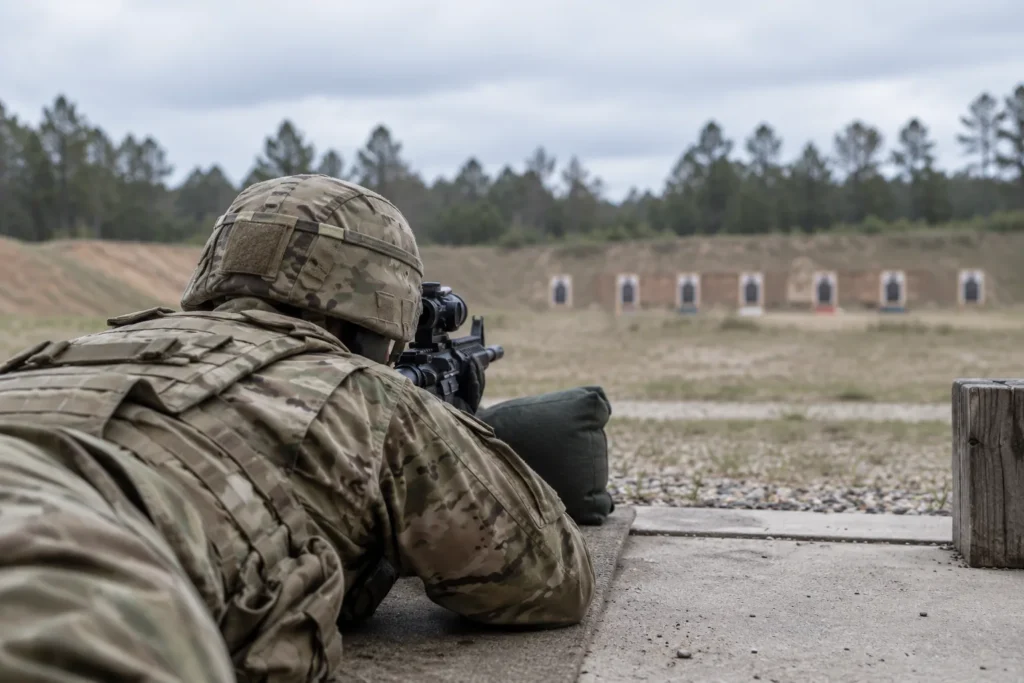
Weapons qualification caps at 160 points for sergeant and 110 for staff sergeant. Points scale with hits, using Table 3-2 in AR 600-8-19 for sergeant and Table 3-3 for staff sergeant. The 110 cap for E-6 surprises people who assume both ranks pay the same for a max qualification.
Your score comes from the most recent qualification with your assigned primary weapon. That weapon has to be linked to you in the Digital Training Management System, called DTMS. The link has to exist at least one day before you shoot. If no primary weapon is designated, the system awards zero.
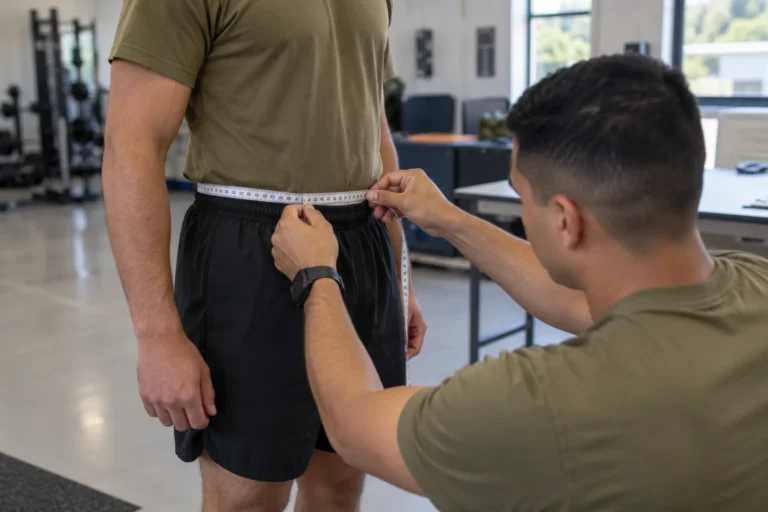
The Army Fitness Test caps at 120 points for both ranks. Table 3-4 in AR 600-8-19 converts your aggregate AFT score into promotion points. Since the AFT tops out at 500 points across five events, your raw total drives everything here.
Two soldiers with identical qualification scores can sit 60 points apart on fitness alone. Most soldiers do not know where their five events currently land. Score your raw numbers first, then work backward.
Soldiers on permanent profiles receive 60 points for each waived event and use their actual score on every event they perform. Those modified totals still count toward promotion points.
Do Weapons Qualification Points Expire?
Yes. A qualification score older than 24 months earns zero promotion points under AR 600-8-19. Soldiers assigned to an organization without an assigned primary weapon can use their latest qualification as an exception. Once they move to a unit with weapons, they get 12 months to qualify before that older score drops off.
Military Education Points
Military education caps at 240 for sergeant and 245 for staff sergeant. It is the single largest category for E-6 and the second largest for E-5.
Two sub-caps sit inside it. Resident training caps at 110 for sergeant and 115 for staff sergeant. Computer-based and correspondence training caps at 90 for both ranks. Neither sub-cap stacks past the overall category ceiling.
Resident courses listed in the Army Training Requirements and Resources System, called ATRRS, pay four points per 40-hour training week. Ranger, Special Forces, and Sapper qualification courses pay 40 points each once every phase is complete. Correspondence work pays one point per five hours, and only whole courses count. A half-finished course pays nothing.
Leader course completion changed the math. ALARACT 030/2024, released 15 May 2024, added 150 promotion points for Basic Leader Course graduates recommended for sergeant. Advanced Leaders Course graduates recommended for staff sergeant receive the same 150. That message added the points to the total score as an exception to policy.
The 6 March 2026 edition of AR 600-8-19 modified that policy. It changed how those course points are awarded to soldiers on the promotion recommended roster. Academic honors carry their own value on top. Commandant’s List pays 20 points. Distinguished Honor Graduate and Distinguished Leadership Graduate each pay 40. Pull your own worksheet in IPPS-A and confirm the 150 posted, because the 800 ceiling still governs your total.
Some courses pay nothing by rule. Basic combat training, advanced individual training, MOS-producing courses, badge-producing courses, language training, and Federal Emergency Management Agency courses are all excluded. On-the-job training and Sergeant’s Time Training pay nothing.

Does Maxing One Category Help You Anywhere Else?
No. Each cap is hard and separate. A sergeant who earns 300 points of resident training still receives 110. The surplus does not spill into awards or civilian education. Airborne Advantage is the notable exception, since AR 600-8-19 awards those points without regard to the maximum point rules.
Awards, Badges, and Achievements
Awards, decorations, and achievements cap at 145 for sergeant and 165 for staff sergeant. E-6 outpaces E-5 here by a wide margin. That gap matches the longer record a staff sergeant candidate brings.
Decorations pay by tier. The Bronze Star Medal pays 30 points and the Purple Heart pays 30. The Meritorious Service Medal pays 25 and the Army Commendation Medal pays 20. The Army Achievement Medal and the Good Conduct Medal pay 10 each. Multiply the point value by the number of awards received.
Badges pay separately and do not stack within a family. The Expert Infantryman Badge, Expert Soldier Badge, and Expert Field Medical Badge each pay 60 points. Those are the largest single badge values in the table. The Combat Infantryman Badge, Combat Medical Badge, and Combat Action Badge pay 30 each. Air Assault and Parachutist pay 10.
Earning a senior or master version of a badge raises your score only by the difference between the two. A soldier who earns the Master Recruiter Badge holds 20 points total, not 35.
Certificates of achievement pay 5 points each, capped at 20. Four certificates fill that sub-cap and a fifth pays nothing. The 6 March 2026 revision also added the Technician Badge to the badge table.
Civilian Education Points
Civilian education caps at 135 for sergeant and 160 for staff sergeant. College credit pays two points per semester hour from a school accredited by the U.S. Department of Education.
Sixty-eight semester hours fill the E-5 cap. Eighty fill the E-6 cap. Quarter hours, contact hours, and clock hours all convert to semester hours before they count, and continuing education units pay nothing.
Finishing a degree pays 20 points on top of the credit hours. A sergeant competing for staff sergeant has to have earned that degree while holding sergeant to collect those points.
Technical certifications pay on a sliding scale. MOS-enhancing credentials approved by Human Resources Command pay 15 each, professional development credentials pay 10, and nationally recognized personal credentials pay 5. Any mix caps at 50 points, and recertifying the same credential pays nothing twice. Credentials your MOS already requires pay nothing at all.
The Defense Language Proficiency Test pays 25 points at a 1/1 rating or better in listening, reading, or speaking. Those points stay valid only while your proficiency rating is current within one year of the point compilation month.
Where Other Sites Get the Category Count Wrong
One ranking site publishes five categories on one page, six on another, and twelve on a third. All three pages describe the same 800-point system for the same two ranks. Only one count can be right, and none of those three is.
AR 600-8-19 lists four scored categories for Regular Army and Army Reserve soldiers. Military training, awards, military education, civilian education. That is the full list.
The same pages list a promotion board score worth up to 150 points and call it a category you cannot self-calculate. For Regular Army and Army Reserve soldiers, that category does not exist. Promotion points are calculated automatically from record data in IPPS-A. Your local board recommends you onto the promotion recommended roster; it does not hand out points.
Army National Guard soldiers work under a different chapter of the same regulation. Guard promotion boards run annually and combine administrative points with board points, under chapter 6 of AR 600-8-19. Applying that Guard structure to an active-duty soldier produces a number the system will never show.
Two other figures circulate widely and both are wrong. Weapons qualification does not cap at 160 for both ranks, since staff sergeant caps at 110. There is also no separate “other training” category worth 35 points.
Why Two Soldiers With the Same Record Get Different Totals
Records and paperwork are not the same thing. Promotion points come from what IPPS-A can see, and IPPS-A can only see what somebody entered.
An award without a posted DA Form 638 pays nothing. A resident course missing from your ATRRS transcript pays nothing. A qualification fired without a primary weapon designated in DTMS pays nothing. The soldier who chases those entries outscores the soldier who assumes they posted.
AR 600-8-19 puts that responsibility on you by name. The regulation puts accuracy on every soldier who has access to their own data. It also tells you to act immediately once you spot an error. Nobody in your chain owns your army promotion points more than you do.
College transcripts cause the most quiet losses. Soldiers with credit from several schools often have it scattered across separate transcripts that were never consolidated. Your local education center can assess the total non-duplicated credit and give your unit one source document to update the system.
How Long Does a Correction Take to Show Up?
Corrections follow the promotion cycle, not the calendar. Data recorded successfully in February affects your points for the April promotion month. AR 600-8-19 does not allow score corrections outside the cycle for missing or incomplete record information. A late fix moves you in a later month.
Where Do SGT Promotion Points and SSG Promotion Points Differ Most?
Military training and civilian education. SGT promotion points lean 50 points harder on weapons and fitness. SSG promotion points shift 25 points into civilian education and 20 into awards. Military education barely moves, rising only 5 points between the two ranks.
Is 248 Points Enough to Get Promoted in the National Guard?
There is no fixed number. Army National Guard promotions to sergeant and staff sergeant are run by each state, not by the Army-wide monthly cutoff that HRC publishes. Guard boards run once a year under chapter 6 of AR 600-8-19 and rank every eligible Soldier on a state promotion list.
When a vacancy opens in your MOS, the top eligible name on that list is promoted. So 248 points can be enough in one state and MOS and not in another. Check where you sit on your state’s Enlisted Promotion System (EPS) list in IPPS-A, or ask your readiness NCO.
How Many Promotion Points Do You Need for E-5?
There is no set number for active duty either. You need to meet or beat your MOS cutoff for the month. In September 2026, infantry (11B) sergeant was 200 points. See the current list on our Army cutoff scores page.
Your Total Is Only Half the Equation
A high score does not promote anyone by itself. Human Resources Command publishes cutoff scores by military occupational specialty every month. Your total gets compared against the cutoff for your MOS and rank. Meet it and you promote. Miss it by one point and you wait.
Cutoffs move. They track open slots in your MOS, how many soldiers compete for them, and overall strength targets. A shortage MOS can promote at a total that would not come close in a crowded one.
That makes any general benchmark useless. No score counts as good across the board. The same total can sit comfortable in one MOS and 200 points short in another. Track the cutoff trend for your own MOS across several months instead of comparing yourself to a soldier in a different job.
Build army promotion points even when you sit far from today’s cutoff. Cutoffs rise without warning, and record corrections take a full cycle to land. A soldier who waits for the cutoff to drop is always a month behind the soldier who already banked the points.
What Counts Toward Your Score, and What Does Not
The fastest way to read your own gaps is to sort your record into what the regulation pays for and what it ignores.
Paid: qualification hits within 24 months, your record AFT score, permanent awards and decorations, badges, up to four certificates of achievement, ATRRS resident courses, completed correspondence courses, accredited college credit, approved credentials, and a current DLPT rating.
Not paid: expired qualifications, MOS-producing schools, badge-producing schools, FEMA courses, partial correspondence courses, continuing education units, on-the-job training, and any credential your MOS already requires.
Frequently Asked Questions
What to Do Next
Pull your worksheet in IPPS-A this week and write down all four subtotals. Subtract each one from the cap for the rank you are competing for. The largest gap is where your next 30 days go.
If your fitness score is the gap, that one moves fastest. Fitness pays up to 120 points on the same scale for both ranks. See what each event pays by age bracket and pick the two with the most room.
Any promotion points calculator you find online is an estimate. The number in IPPS-A is the one that promotes you. Army promotion points count only once they are posted there.
Sources: AR 600-8-19, Enlisted Promotions and Demotions, dated 6 March 2026, effective 6 April 2026. Army Directive 2025-06 (Army Fitness Test). ALARACT 030/2024, DTG R 151209Z MAY 24. Category maximums verified against the Deputy Chief of Staff, G-1 memorandum, Promotion Point Changes for Promotion to Sergeant and Staff Sergeant. Armygrader.com is an independent reference site and is not affiliated with the U.S. Army or the Department of Defense.