RULES AND SCORING
Combat MOS List : All 24 Army Specialties
Every code that carries the 350 standard, taken line by line from Enclosure 2 of Army Directive 2026-07.
Twenty-four codes sit on the combat MOS list. Enclosure 2 of Army Directive 2026-07 names every one. Three were added in April 2026. Soldiers in these specialties take both the AFT and the Combat Field Test.
That count changed this year. Many published rosters still carry the older number. The table below gives the codes exactly as the directive prints them.
Combat MOS Army Codes: The Full Enclosure 2 List
This list of combat MOS Army 2026 codes comes straight from Enclosure 2 of Army Directive 2026-07. Nothing below is paraphrased. Only the branch labels are added, to make the table easier to scan.
Branch group | Code | Official title |
|---|---|---|
Infantry | 11A | Infantry Officer |
Infantry | 11B | Infantry Soldier |
Infantry | 11C | Indirect Fire Infantry Soldier |
Infantry | 11Z | Senior Infantry Leader |
Engineer | 12A | Engineer Officer |
Engineer | 12B | Combat Engineer |
Engineer | 12D | Army Diver |
Field Artillery | 13A | Field Artillery Officer |
Field Artillery | 13F | Fire Support Specialist |
Special Forces | 180A | Special Forces Warrant Officer |
Special Forces | 18A | Special Forces Officer |
Special Forces | 18B | Special Forces Weapons Sergeant |
Special Forces | 18C | Special Forces Engineer Sergeant |
Special Forces | 18D | Special Forces Medical Sergeant |
Special Forces | 18E | Special Forces Communications Sergeant |
Special Forces | 18F | Special Forces Assistant Operations and Intelligence Sergeant |
Special Forces | 18Z | Special Forces Team Sergeant |
Armor and Cavalry | 19A | Armor Officer |
Armor and Cavalry | 19C | Bradley Fighting Vehicle Crewman |
Armor and Cavalry | 19D | Cavalry Scout |
Armor and Cavalry | 19K | M1 Armor Crewman |
Armor and Cavalry | 19Z | Armor Senior Sergeant |
Explosive Ordnance Disposal | 89D | Explosive Ordnance Disposal Specialist |
Explosive Ordnance Disposal | 89E | Explosive Ordnance Disposal Officer |
Source: Army Directive 2026-07, Enclosure 2 (Combat Specialties).
Count the rows and you get 24. Special Forces carries eight entries, more than any other branch. Armor and Cavalry follows with five. Infantry has four. Engineer has three. Field Artillery and EOD have two each.
Your AFT MOS status is set by this table alone. Duty position does not change it. An Infantryman working a staff job stays 11B on paper. He keeps the higher standard with him.
How to Read the Combat MOS List
Enclosure 2 mixes enlisted codes, warrant officer codes and officer areas of concentration. Codes ending in A are officer AOCs, such as 11A, 12A, 13A and 19A. Codes ending in Z are senior enlisted leader codes, such as 11Z, 18Z and 19Z.
A code absent from Enclosure 2 carries the general standard. No field test is scheduled for it. There is no partial designation and no unit-level discretion here.
Special Forces takes up a third of the roster because each SF skill sits in its own code. Weapons, engineer, medical, communications and intelligence sergeants are graded separately. All of them land in the same scoring column.
The Three Specialties Added in April 2026
Army Directive 2026-07 added three designations. Paragraph 4.b.(2) names them directly. They are 12D Army Diver, 89D Explosive Ordnance Disposal Specialist and 89E Explosive Ordnance Disposal Officer. The diver code groups with the Engineer series.
The directive requires Soldiers in these three to meet the AFT combat standard in AR 350-1, paragraph C-5. It also designates them for the field test. Both requirements arrived together on 17 April 2026.
That pairing matters. Earlier coverage sometimes treated the field test roster and the AFT combat roster as two separate lists. Army Directive 2026-07 uses a single enclosure for both.
Divers and EOD technicians already moved heavy loads daily. Dive gear, bomb suits and render-safe equipment are not light. The directive brought the written standard in line with the work.
Why You Still See 21 Instead of 24
Twenty-one was correct until 17 April 2026. Army Directive 2025-06, signed 17 April 2025, set the original roster at 21 codes. Every scoring timeline built during 2025 used that figure.
Army Directive 2026-07 superseded that earlier directive in part. It added 12D, 89D and 89E. The roster moved to 24 and has stayed there since.
Even the Army’s own public fitness page at army.mil/aft still shows 21 in its implementation timeline. That timeline describes the 1 January 2026 and 1 June 2026 effective dates. At those dates, 21 was accurate. The page has not been refreshed to reflect the April 2026 addition.
So the honest answer has two halves. Twenty-one applied during the combat standard phase-in. Twenty-four applies now, under Enclosure 2 of Army Directive 2026-07. Any roster published after 17 April 2026 that still totals 21 has dropped the diver and EOD codes.
Item | Army Directive 2025-06 | Army Directive 2026-07 |
|---|---|---|
Signed | 17 April 2025 | 17 April 2026 |
Combat specialties | 21 | 24 |
Codes added | Baseline roster | 12D, 89D, 89E |
Field test | None | Combat Field Test established |
Status | Superseded in part | Controlling |
Source: Army Directive 2026-07, and Army Directive 2025-06 as cited in Enclosure 1, reference 1c.
Check the date on any roster before you trust it. A page written in early 2026 can be right for its moment and wrong today. The same caution applies to any scoring table you train against.
What the Combat Standard Actually Requires
The army MOS fitness standards split into two totals. General standard is 300 points. Combat standard is 350 points. Both demand at least 60 points on every one of the five events.
That 300 is arithmetic. Five events at the 60-point floor add to 300. No separate gate sits behind it.
Scoring for the combat standard is sex-neutral and age-normed. It uses the male scoring column. No third table exists. You can score all five events against the 350 total before your next record test.
An 11B AFT result is measured against 350, not 300. A 12B AFT result is judged the same way. Every 18-series AFT taker sits in the combat column, from 18B through 18Z. So does 180A.
Age brackets still apply to the combat standard. The scales run across ten brackets, from 17-21 up to Over 62. The age bracket tables show where each raw performance lands.
A single event below 60 fails the whole test. A Soldier scoring 400 total with one event at 58 has failed. Fix the weak event first, then chase the total.
Who Has to Take the Combat Field Test?
Only Soldiers in the 24 specialties listed in Enclosure 2. Everyone else takes the AFT alone.
Regular Army and Active Guard Reserve Soldiers take one field test and one record AFT each year. The same applies to Reserve Component Soldiers on active-duty orders of 365 days or more. Other Reserve Component Soldiers alternate instead. They take a record AFT one calendar year and a record field test the next.
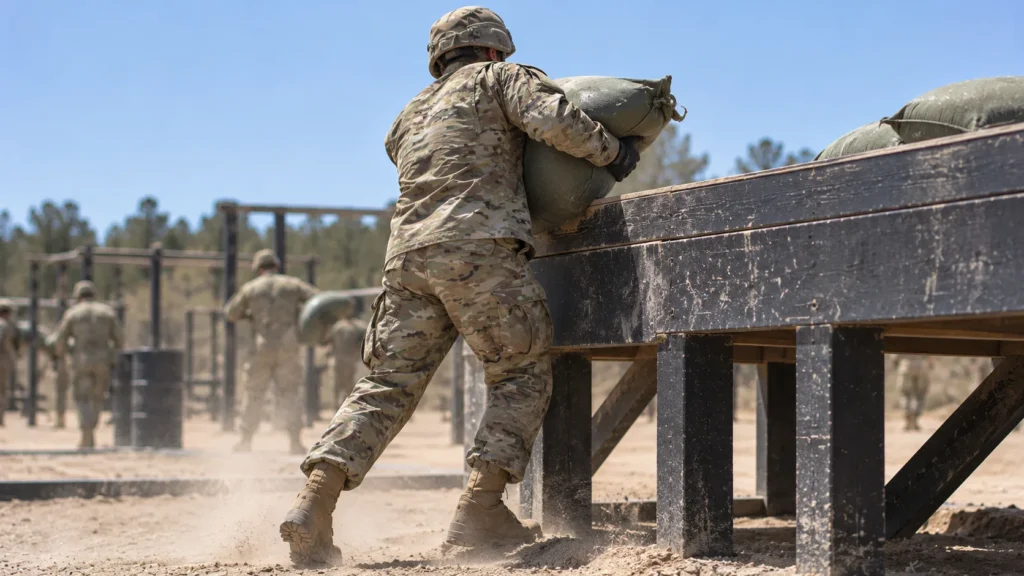
The field test does not replace the AFT. Army Directive 2026-07 states this in paragraph 4.a.(5). Read the seven events and the 30-minute clock for the full sequence.
Feature | AFT | Combat Field Test |
|---|---|---|
Events | 5 | 7 |
Scoring | 0 to 100 per event, 500 max | Pass or fail, no points |
Combat total | 350 | Not applicable |
Uniform | APFU | ACU top and bottom, brown t-shirt, boots |
Headgear | Worn per local policy | None worn |
Who takes it | All Soldiers | 24 combat specialties only |
Norming | Age-normed | Neither age nor sex |
Source: Army Directive 2026-07, paragraphs 4.a.(2) through 4.a.(5).
Army Directive 2026-07 also sets minimum spacing between tests in paragraph 4.a.(6). Regular Army and AGR Soldiers leave at least four months between a record field test and a record AFT. Reserve Component Soldiers on 365-day orders follow the same four-month rule. For other Reserve Component Soldiers the gap is eight months. Those Soldiers may still take an extra record AFT inside that window for promotion or schooling. Plan the gap between your two record tests around that rule.
The uniform detail catches people out. The field test runs in ACUs and combat boots, with no headgear. Events run in sequence and the clock keeps running throughout.
What Happens If You Fail the Field Test?
Nothing permanent, for now. Army Directive 2026-07 sets a one-year implementation period. No administrative action follows a failed field test for 365 days. That window closes on 17 April 2027.
After that date, a failure brings a flag and reconditioning training under Field Manual 7-22. Retest is 90 days for Regular Army and AGR Soldiers. It stretches to 180 days for Reserve Component Soldiers outside those categories.
A 19D AFT failure follows the same 90-day retest rule on active duty. The two tests run on separate clocks. Passing one does not excuse the other.
Two consecutive field test failures open the door to reclassification. Enlisted Soldiers face action under AR 635-200, chapter 13. Officers face elimination under AR 600-8-24, paragraph 4-2(a). A waiver can stop that. Authority sits with the general court-martial convening authority, or the first general officer in the chain.
Can You Leave a Combat Specialty?
Yes, through reclassification. A Soldier who cannot hold the standard may seek a move to a code outside Enclosure 2. A permanent profile blocking any primary AFT event makes a Soldier ineligible for the field test. A reclassification review follows, with waiver authority sitting at general officer level.
Body composition now sits on a separate track. The waist-to-height measurement replaced the tape test and the height and weight tables in July 2026. Your code does not change that standard.
Frequently Asked Questions
What to Do Next
Find your code in the Enclosure 2 table above. If it is there, you owe a 350 total on the AFT. One field test joins your annual cycle as well. If your code is absent, the 300 general standard applies and no field test is scheduled.
Confirm your designation with your unit S1 before building training around it. Then work out the points you still need and check what the field test involves. Only a certified grader entering a result into DTMS produces an official score, whatever any calculator shows you. The combat MOS roster holds at 24 until the Army publishes the revised regulations that rescind this directive.