EVENT TRAINING
Hand Release Push Up Standards and How to Add 20 Reps
The hand release push up is event two of five on the Army Fitness Test. You get two minutes. A 22 to 26 year old male needs 14 correct reps for 60 points and 61 for 100.
The hand release push up is scored on repetitions the grader counts, not repetitions you attempt. That gap between 14 and 61 is where most soldiers lose points. Closing it takes about eight weeks of honest work and a hard fix on your form.
Army Push Ups on the AFT: What Actually Counts
Army push ups changed when the AFT replaced the ACFT on 1 June 2025 under Army Directive 2025-06. Army push ups are now graded under one protocol, the arm extension version, and scored on one approved table.
Here is the correction you need first. Several pages still describe a six-event test and list this event as number three. That is the retired ACFT layout. The AFT has five events. The Standing Power Throw is gone. The HRP sits at position two, between the 3 Repetition Maximum Deadlift and the Sprint-Drag-Carry. If a training plan you found is built around six events, it is out of date.
The AFT push ups event runs for a fixed two-minute window. You start prone, not in the front leaning rest. Every rep ends with your chest, hips and thighs back on the deck. Each event scores 0 to 100. You need 60 on all five to pass, which puts the general standard at 300 and the combat standard at 350.
The push up standards Army graders apply come from a single source, the AFT Scoring Scales approved 15 May 2025. There is no separate unit table and no local variation. Only a certified grader entering your result into DTMS produces an official score.
The combat column matters here. The AFT tables print two columns per age bracket, “M | C” and “F”. The male and combat column is one column. A soldier in a combat MOS is scored against it regardless of sex. Army Directive 2026-07, dated 17 April 2026, brought the count of designated combat MOSs to 24. If you hold one, read the left column of your bracket.
Failing this event starts a fixed clock. Active duty and AGR soldiers retest within 90 days. Reserve Component soldiers retest within 180 days. A 120 to 180 day window still shows up on older training slides. That figure belongs to the retired ACFT directive, AD 2022-05, and no longer applies.
The HRP also has no substitute. Alternate events exist for the two-mile run, and those are graded go/no-go rather than on the 0 to 100 scale. Nothing in the approved tables offers an alternate upper-body event, so there is no way around this one.
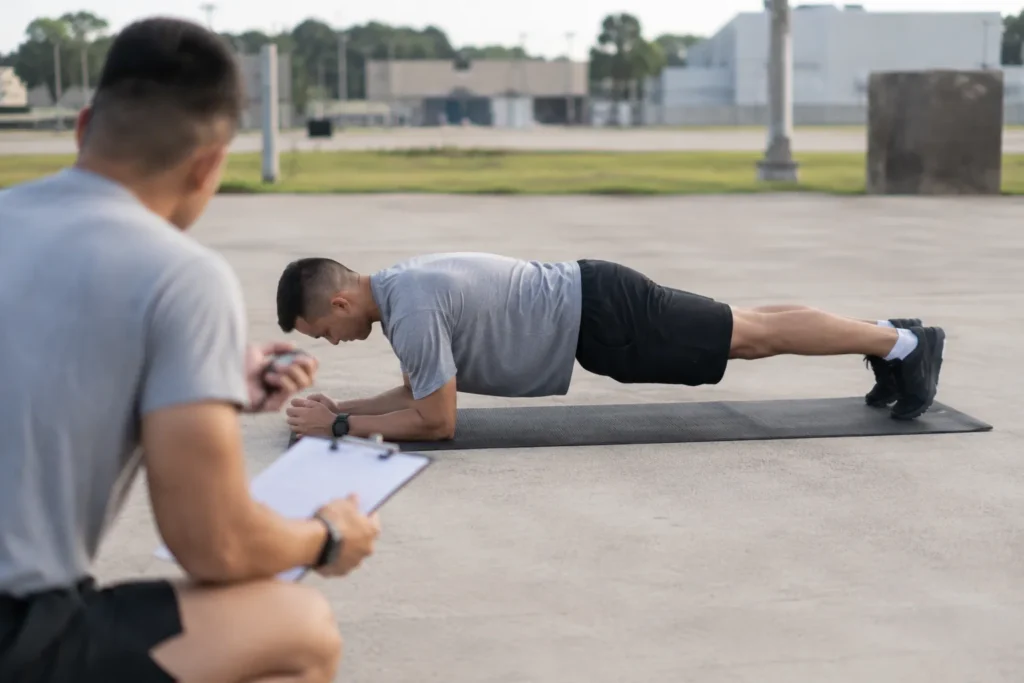
The event itself needs almost nothing. A level surface is the only equipment the standard lists. You test in lanes, one soldier per lane, and your grader works your lane alone.
Test-day order catches people out. The HRP runs after the 3 Repetition Maximum Deadlift, so you reach it with your grip and lower back already taxed. Soldiers who only ever train the movement fresh get an unpleasant surprise. Put some of your work in after a heavy pull.
Nothing here changes by component. HRP Army standards are identical for active duty, Reserve and National Guard soldiers in the same bracket and column. Only the retest window shifts.
HRP Army Standards by Age Bracket
HRP Army standards run across ten age brackets. Correct reps in two minutes:
Age bracket | 60 pts (M / Combat) | 60 pts (F general) | 100 pts (M / Combat) | 100 pts (F general) |
|---|---|---|---|---|
17-21 | 15 | 11 | 58 | 53 |
22-26 | 14 | 11 | 61 | 50 |
27-31 | 14 | 11 | 62 | 48 |
32-36 | 13 | 11 | 60 | 47 |
37-41 | 12 | 10 | 59 | 43 |
42-46 | 11 | 10 | 57 | 40 |
47-51 | 11 | 10 | 55 | 38 |
52-56 | 10 | 10 | 51 | 36 |
57-61 | 10 | 10 | 46 | 24 |
Over 62 | 10 | 10 | 43 | 24 |
Source: AFT Scoring Scales, approved 15 May 2025, effective 1 June 2025.
Twenty reps is a realistic eight-week gain if you currently sit between 15 and 35. Above 45 you are fighting for singles. Below 12 you should expect a bigger jump than twenty.
Three things add reps. Higher training volume, better positions, and a pacing plan. Most soldiers only train the first one.
Find your ceiling first
Three limits show up on this event. Work out which one you have before you pick a plan.
Pressing strength caps you if your reps stay low even when you are fresh. A soldier stuck at 12 needs load, not volume.
Core endurance caps you if the first fifteen reps look clean and the rest get called for hip lag. That is a plank problem wearing a push-up costume.
Pacing caps you if you can hit your target in sets but not inside the clock. That one is the easiest to fix and the most common.
Test yourself. Do a two-minute max, rest five minutes, then do a second one. If the second number lands close to the first, you have pacing room to gain. If it collapses, you are looking at a strength or endurance ceiling.
Weeks one to four: build volume
Train the movement three days a week on non-consecutive days. Use greasing the groove, which means many small sets spread through the day rather than a few sets to failure.
Take your current max. Call it M. Do sets of roughly 40 percent of M, six to eight times per training day, with at least twenty minutes between sets. A soldier maxing at 25 does sets of 10. That is 60 to 80 reps a day at a quality you can hold.
Never train to failure in this block. Failure teaches sloppy positions under fatigue, and the grader calls those.
Add one supporting lift each session. Two options work well:
• Incline or flat dumbbell press, three sets of eight to twelve
• Ring rows or barbell rows, three sets of ten, to keep the shoulders balanced
Add a two-minute hollow hold or a weighted plank. The hips sag before the arms fail on most failed attempts.
Weeks five to eight: build the specific pattern
Switch to cluster sets. Do five reps, rest fifteen seconds, repeat. Run that for a full two minutes and count the total. This trains the exact energy system the two-minute window taxes.
Keep one heavy pressing day in the week. Three sets of five on a bench or floor press holds the strength you built in the first block. Endurance work on its own will slowly drain your top-end pressing power.
Do one timed two-minute test every two weeks. Not weekly. Testing too often eats the recovery that produces the gain.
Film one of those tests from the side. You will see hip lag on video that you cannot feel while your chest is on the deck.
In the last ten days, cut volume by about half and keep the intensity. You want to arrive fresh, not fried.
Run your projected number through the scoring tool on this site to see what the added reps are worth against your other four events. Sometimes twenty reps buys you eight points. Sometimes it buys you thirty.
What Is a No Rep Hand Release Push Up?
A no-rep is any repetition the grader does not count. It still costs you two to three seconds of your two-minute window, so no-reps are expensive twice over.
The official movement has four parts, per the Army’s event standard and ATP 7-22.01:
1. From prone, push the whole body up as one unit to full elbow extension.
2. Bend the elbows and lower until chest, hips and thighs touch down together.
3. Without moving head, body or legs, extend both arms straight out to the sides into the T position.
4. Return the hands under the shoulders to start the next rep.
Common no-rep calls:
• The hips lag or lead. The body must move as one unit in generally straight alignment.
• Chest to deck without the hips and thighs. Worming is the most common fault under fatigue.
• Bent elbows in the T. The arms must reach generally straight out to the side.
• Index fingers outside the outer edge of the shoulders at the start position.
• Feet more than a boot’s width apart.
Now correct a second widespread error. Many pages state that your hands must visibly lift clear of the ground on every rep. The current standard does not require that. The event standard says the arms and hands may touch or slide along the ground during the hand-release movement. What the grader is checking is arm extension into the T. That distinction matters, because soldiers waste energy popping their hands up when a slide costs nothing.
Read movement three closely. The rule governs your arms, not your hands. Your head, body and legs stay still while the arms travel out to the side. Soldiers who lift the chest slightly to help the arms move give away a rep every time.
Two faults end the event rather than costing a single rep. Lifting a foot off the ground, or lifting a hand off the ground while resting in the front leaning rest, terminates the test after a warning.
A warning is not a failed test. It is a correction. Fix the fault on the very next rep and keep working the clock. Soldiers who argue a call lose more time than the no-rep cost them.
You may adjust your feet during the event as long as neither foot leaves the ground. Sliding them back into position is allowed. Picking one up to reset is not.
How Many Push Ups for 100 Points AFT?
For the male and combat column it runs from 43 reps in the Over 62 bracket to 62 reps at 27-31. Women on the general standard need between 24 and 53. Your exact number depends on your bracket, so read the row, not the average.
Here is what the middle of the scale looks like for the male and combat column:
Points | 17-21 | 22-26 | 27-31 | 32-36 | 37-41 |
|---|---|---|---|---|---|
60 | 15 | 14 | 14 | 13 | 12 |
70 | 28 | 26 | 26 | 26 | 24 |
80 | 37 | 37 | 37 | 36 | 35 |
90 | 46 | 48 | 48 | 47 | 46 |
100 | 58 | 61 | 62 | 60 | 59 |
Read the jump from 60 to 70 points. A 22 to 26 year old male buys ten points for twelve reps. From 90 to 100 he pays thirteen reps for the same ten points. The cheap points sit in the middle of the table, not at the top.
One detail almost nobody publishes. Below 60 points the scale goes flat and stops caring about your age. Nine reps scores 50 points in every bracket and both columns. Eight scores 40, seven scores 30, six scores 20, five scores 10, four scores 0.
That creates a hard cliff. A 27-31 male at 13 reps scores 50 points and fails the event. One more rep puts him at 14 and 60 points, and he passes. One repetition is worth ten points and the difference between pass and fail. Check where your number lands using the event calculator here before you assume you are safe.
Points here weigh the same as points anywhere else on the AFT. Ten points on the HRP counts exactly as much toward your total as ten points on the deadlift or the run. Soldiers tend to chase the run because it feels more serious. This event is usually cheaper ground.
Check your weakest event before you commit to a training block. Twenty extra reps buy you nothing if you already score 100 here and sit at 62 on the plank.

Hand Release Push Up vs Regular Push Up
The two movements load your body differently, which is why strong push-up soldiers still get low HRP scores.
Factor | AFT event | Regular push-up |
|---|---|---|
Start position | Prone, chest on the deck | Front leaning rest |
Bottom of rep | Chest, hips, thighs touch together | Chest near the ground |
Between reps | Arms extend into the T position | Elbows stay bent, no reset |
Stretch reflex | Removed, every rep starts dead | Available, momentum carries |
Rest position | Front leaning rest only | Any position |
Scoring | Correct reps in a two-minute window | Untimed or self-timed |
Killing the stretch reflex is what makes this hard. In a regular push-up the descent stores energy that helps the ascent. Here you unload at the bottom every single time. Each rep starts from a dead stop.
Expect to lose roughly a third of your regular push-up number when you switch. A soldier who does 45 standard push-ups often lands near 30 on the AFT version.
Shoulder range shows up as a second difference. Reaching your arms into a straight T from the floor asks for mobility a regular push-up never tests. Soldiers with tight chests and lats hit that wall before their pressing strength gives out.
Test your T position cold, before any pressing work. If your elbows will not straighten out to the side while your chest stays down, range is costing you reps and no amount of volume will fix it.
Wrist loading differs too. In a regular push-up your hands stay loaded through the whole set. Here they unload and reload on every repetition, which asks more of the wrist each time you drop back onto the deck.
Carryover runs one direction. Training the graded version improves your regular push-up almost automatically. The reverse does not hold. Hundreds of standard reps build pressing endurance and still leave you short on the reset, the T position and the dead-stop start.
Train the graded movement, not the one you are already good at.
Test Day: Pacing the Two-Minute Window
Set a pace before you start. Most soldiers go out at maximum speed, blow up around forty seconds, and then grind through no-reps for the rest.
A steady rep every two to three seconds is sustainable. That is 40 to 60 reps across the full window if your positions hold.
Break the two minutes into four thirty-second blocks. Assign a rep target to each block and hold it. If your target is 40, that is roughly 12, 11, 9 and 8.
Rest in the front leaning rest, not on the ground. The ground is not an authorized rest position, and stopping there invites a termination call if a hand comes up.
Watch your hands on the reset. Fatigue drifts them outward, and index fingers outside the shoulder line stop counting reps.
Warm up the T position on its own. A few slow reps through the full range beat general arm swings, because the position that fails first is the one worth rehearsing.
Set your feet before the command. A boot’s width apart at most, ankles flexed, toes on the ground. Fixing foot position after the clock starts costs reps you never get back.
Breathe on a fixed rhythm. Exhale on the press, inhale on the way down.
Keep a rough count in your own head as a backup. Your grader owns the official count, and you still want to know where you stand at ninety seconds so you can decide whether to push or hold pace.
Frequently Asked Questions
What to Do Next
Test yourself honestly this week under a real two-minute clock with a battle buddy calling your no-reps. That number, not your gym push-up number, is your starting point.
Then pick your target from your age bracket, work the eight-week build, and retest every two weeks. A disciplined hand release push up plan moves most soldiers twenty reps, and on this event twenty reps is often twenty points.
Bring your current and target rep counts to the AFT scoring tool and see what the change does to your total before you commit to the block.