COMBAT FIELD TEST
Dead Stop Push Up Rules for the Army Combat Field Test
How CFT event 2 is graded, how it differs from the AFT hand-release push-up, and which technique the directive actually requires.
The dead stop push up is CFT event 2. You perform 30 correct reps before moving on. None of them are scored. The hand-release push-up is AFT event 2, scored 0 to 100 in two minutes.
Same body position. Different rules, different counting, different consequences for a bad rep. Soldiers in combat specialties now take both tests in the same year. That is where the confusion starts.
Short answer: a dead-stop push-up is event 2 of the Combat Field Test. You do 30 reps: chest to the ground, a full stop with your hands released, then push back up. It is not scored on its own. All seven CFT events must be finished in 30 minutes or less, in uniform and boots.
Dead Stop Push Up vs Hand Release Push Up: What Actually Differs
The dead stop push up vs hand release push up gap is smaller than most soldiers expect. It sits almost entirely in the hands. Both movements put your chest on the ground. Both force a full stop at the bottom.
What changes is what you do once you get there.
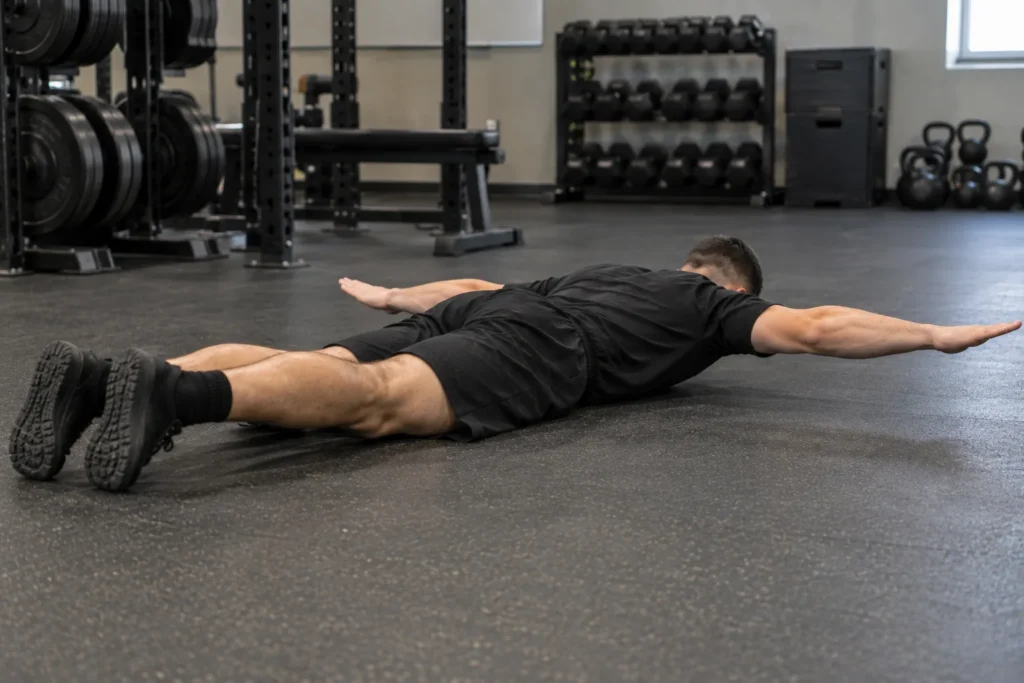
On the Army Fitness Test, the movement has a prescribed shape. Official guidance for AFT event 2 requires both arms extended straight out to the side. That is the T position. The arms and hands may touch or slide along the ground. You then return the hands under the shoulders and press.
On the Combat Field Test, there is no prescribed shape. HQDA EXORD 103-26, Annex B, paragraph B.3.B covers this event. It tells you to lower until the chest meets the ground and lift both hands off the surface. It then states that no technique is specified. It names the T and the hand-release as examples of techniques it is not requiring.
That one line settles most of the arguments happening at unit level.
CFT Dead Stop (Event 2) | AFT Hand-Release (Event 2) | |
|---|---|---|
Reps required | 30, fixed | As many as possible |
Time limit | None on the event itself | Two minutes |
Hand movement | Lift both hands, no technique specified | Both arms to a T position |
Hand placement | Anywhere comfortable | Index fingers inside the outer shoulder edges |
Scored | No, pass/fail on total test time | Yes, 0 to 100 points |
Rest position | Any position, clock keeps running | Front leaning rest only |
Uniform | ACU, belt, brown T-shirt, boots | Unit PT uniform |
Age and sex | Neutral, one standard | Ten age brackets, separate columns |
Recorded in | ATIS | DTMS |
Source: HQDA EXORD 103-26, Annex B, paragraph B.3.B. AFT standards from the AFT Scoring Scales, HQDA EXORD 218-25, Annex B, effective 1 June 2025.
Several sites describe the CFT push-up as a hand-release rep. Some show a T position for it. That is wrong. EXORD 103-26 declines to specify the technique. A grader cannot no-count you for lifting your hands straight up. Sweeping them out to the side is also fine. Neither is required.
If you want the wider picture first, read the full seven-event breakdown and who has to take it.
What Counts as One Repetition on Each Test
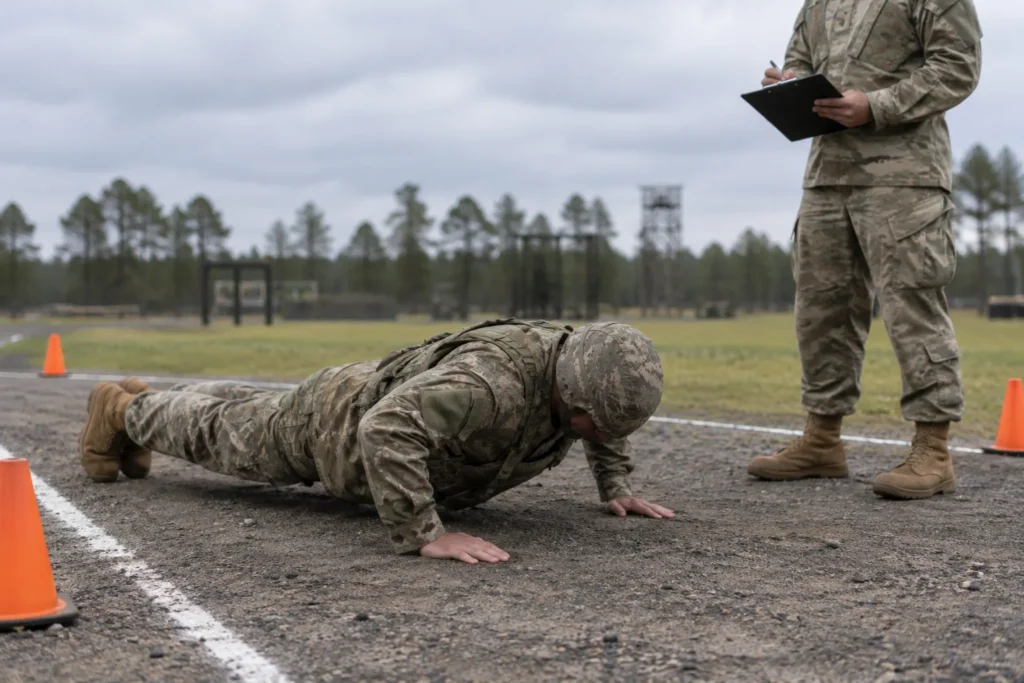
The CFT rep is defined loosely on purpose. Your body forms a generally straight line from the base of the neck to the heels. You lower until the chest meets the ground. You lift both hands. You press back up with knees off the ground. Arms finish generally straight, and the up position mirrors the start.
The AFT rep is defined tightly. Chest, hips, and thighs touch down together. Head contact is optional. Arms go out to the T. Hands come back under the shoulders. Elbows lock out at the top.
One word does the heavy lifting in the CFT standard. That word is “generally.” It appears three times in paragraph B.3.B. The AFT standard uses fixed anatomical checkpoints instead.
This is not sloppiness in the writing. The CFT is a field assessment run in boots and ACUs. It was built to resemble the Expert Physical Fitness Assessment. That is the same event used for the Expert Infantry Badge and the Expert Soldier Badge. Loose technique language keeps graders focused on the clock.
Why the Two Standards Are Written Differently
The AFT measures you. It sorts soldiers across a range and produces a number. A number needs tight definitions. Without them, the same performance scores differently in two units.
The CFT checks you. It asks one question. Can you finish seven events in 30 minutes wearing your uniform? Nothing needs sorting, so nothing needs a tight definition.
Keep that split in mind when a grader questions your form. On the AFT, form controls your score. On the CFT, form controls only whether the rep advances the count. You can see how the scoring side works by looking at the published point tables.
Form Errors That Cost You Reps
Most soldiers lose AFT reps to standards rather than strength. The chest lands before the hips. One arm reaches the T and the other stays tucked. Elbows never fully lock at the top. Feet drift wider than a boot’s width apart.
The CFT punishes far fewer of these. Hands anywhere. Chest down, hands up, press. The only written disqualifier is a knee touching the ground during the rep.
One error carries across both tests. Sagging hips break the straight line, and a broken line means the rep does not count anywhere. Fix that before you worry about hand position. We cover adding reps before test day in a separate guide.
How the CFT Grades Event 2
Graders count out loud. If a rep misses the standard, the grader repeats the last correct number. There is no fault called and no penalty. You keep going until 30 correct reps are on the board.
Knees are the one hard disqualifier written into the paragraph. No repetition counts if your knees stay in contact with the ground during it. Everything else sits inside that word “generally.”
Graders must have read Annex B before running the lane. Unit leadership certifies them. That is a looser bar than the AFT grader requirement. Standards vary between units more than they should.
When a Rep Does Not Count
Nothing dramatic happens. The number simply does not advance. There is no penalty rep and no restart. There is no termination for a sloppy rep, which the AFT does impose for a knee on the ground.
You may stop at any time and rest in whatever position you choose. You cannot move to the sprint until all 30 are complete. After a rest break you return to the original starting position first.
The cumulative clock never stops during any of this. Rest on the push-up lane is expensive. It comes straight out of your 30 minutes. Details on the time standard and the phased rollout sit on the main test page.
Uniform and Surface Change the Movement
You take the CFT in the Army Combat Uniform. That means top and bottoms, a belt, a brown T-shirt, and boots approved under AR 670-1. No cover is worn.
The uniform matters more than soldiers expect on this event. A blouse restricts the shoulder at the bottom of the rep. Boots shift your weight forward. Neither changes the standard, but both change how the reps feel.
Surface matters too. Units run the lane outdoors on whatever ground the course allows. Hands on gravel behave differently than hands on a gym floor. Since the technique is open, find the hand position that works on rough ground.
The AFT has no equivalent constraint. You test in the unit PT uniform. See what a grader checks on every event for the rest of the standards.
Where the Result Gets Recorded
Units input CFT results into the Army Training Information System, known as ATIS. This differs from the AFT. On the AFT, a certified grader entering the result into DTMS is what makes a score official.
Check which system your unit is using before you assume a result posted. Two tests, two systems, and a record test that never lands is a problem you find late.
Hand Release Push Up vs Regular Push Up: Why the Army Uses It
The hand release push up vs regular push up question comes down to the bounce. In a standard push-up your hands stay planted. Tendons store elastic energy at the bottom. A tired soldier rebounds off the chest with less muscular work.
Lifting the hands removes that. Every rep restarts from a static position. The chest, triceps, and shoulders produce the entire movement.
Grading gets easier too. A grader watching a standard push-up judges depth in real time on a moving target. A grader watching for hands off the ground has one clear checkpoint per rep.
ATP 7-22.01 lists the hand-release push-up as one of five AFT events. The others are the 3 Repetition Maximum Deadlift, the Sprint-Drag-Carry, the Plank, and the 2-Mile Run. The Standing Power Throw was retired on 1 June 2025. That is the date the AFT replaced the ACFT under Army Directive 2025-06. We cover what changed when the test of record was replaced in a separate breakdown.
The CFT borrowed the dead stop idea and dropped the arm extension. You get the honest bottom position without the shoulder mobility requirement. That matters in a uniform top, with body armor a realistic follow-on load.
Where the Push-Up Sits in the Full Test
What Are the CFT Events?
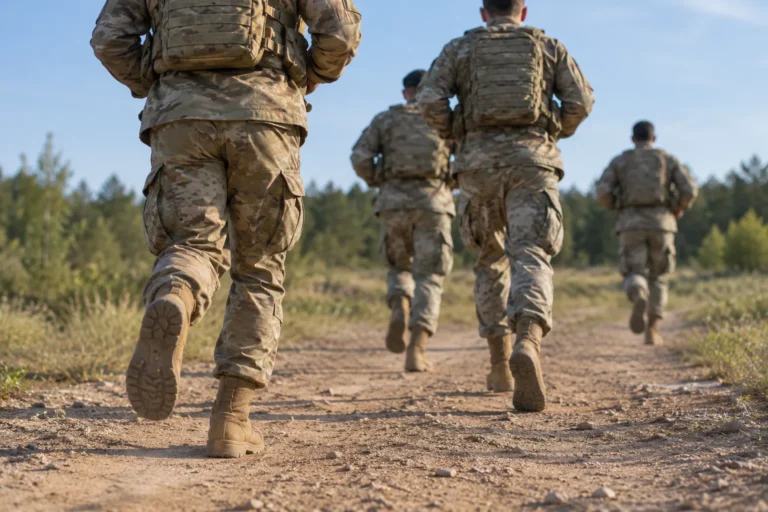
Seven, run back to back on one clock. A 1-mile run, then 30 dead stop push ups, then a 100-meter sprint. Then 16 sandbag lifts, a 50-meter water can carry, and a 50-meter movement drill. A second 1-mile run finishes it.
The CFT events run in that fixed order. No individual event is timed on its own. Only the cumulative time matters.
The whole sequence has to finish in 30 minutes or less. Finish at 30:01 and you failed. The movement drill splits in half. You high crawl 25 meters, then cover 25 meters in 3 to 5 second rushes.
How Many Sandbag Lifts Does the CFT Require?
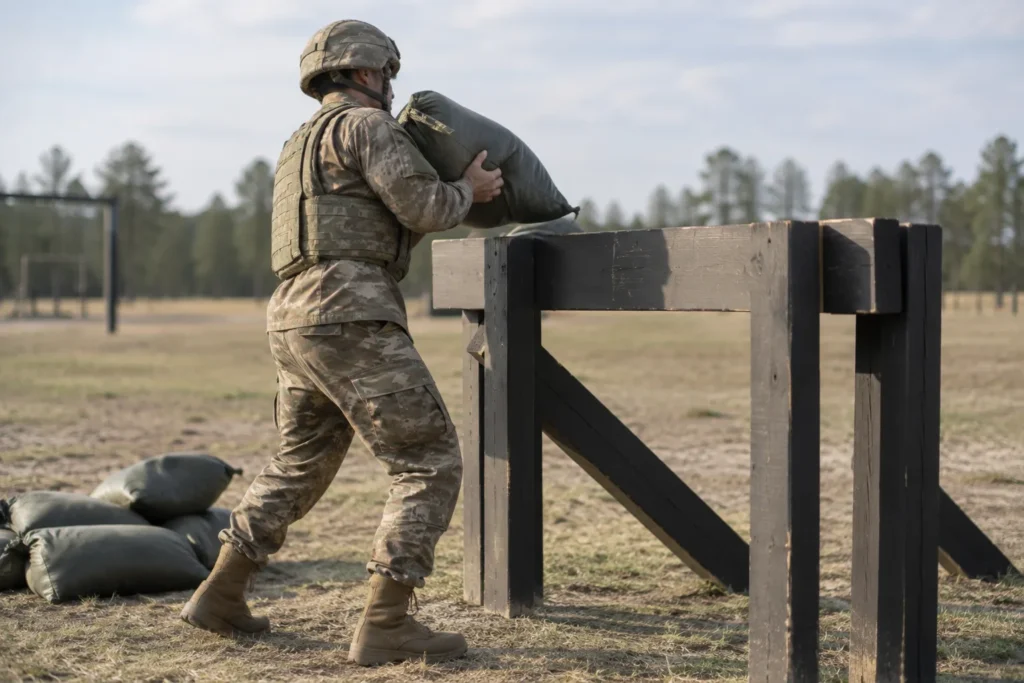
Sixteen. If you are wondering how many sandbag lifts CFT graders count, the number is 16. Each is a 40-pound sandbag lifted onto a 65-inch platform. A bag that falls off gets replaced before you move on.
Graders cannot help you. They will not move bags out of your way or clear the platform early.
Push-ups come immediately after the first mile. That placement matters more than the rep standard does. Train the movement tired, in boots, on grass or gravel rather than a gym floor.
Which Test Do You Take, and When?
The CFT does not replace the AFT. Soldiers in the 24 designated combat specialties take both.
Regular Army soldiers take one record CFT and one record AFT each year. The same applies to USAR and ARNG Active Guard Reserve soldiers. It also covers Reserve Component soldiers on active-duty orders for 365 days or more.
All other Reserve Component soldiers in combat specialties take one record test per calendar year. They alternate, taking a record AFT one year and a record CFT the next.
Some pages still list 21 combat specialties. The Army announcement of 22 April 2026 states 24. Army Directive 2026-07, dated 17 April 2026, added three. Those are 12D Army Diver, 89D EOD Specialist, and 89E EOD Officer. You can confirm your own code against the designated combat specialty list.
The AFT still carries a point score. Most soldiers should run a five-event total well before test week.
Frequently Asked Questions
What To Do Before Test Day
Practice the dead stop push up after a hard mile, in boots, with your hands wherever they are strongest. The technique is open, so use that freedom. Then check the rep count for your age bracket and train to that number instead. The two figures are not the same thing. Only one of them affects a score, and it is not the one you do in boots. Log the dead stop push up as a pass or a fail, nothing more.