PROFILES AND WAIVERS
Can You Get an AFT Waiver?
Yes, but only in one narrow case. An AFT waiver is open to Soldiers in combat specialties whose permanent profile blocks primary AFT events. It keeps you in your MOS. It does not cancel your record tests.
The rule comes from Army Directive 2026-07, signed 17 April 2026. Most Soldiers will never need one. Outside the combat specialties, no waiver process exists. Your profile shapes the test instead.
Who Qualifies for an Army Fitness Test Waiver?
You qualify for an Army Fitness Test waiver only if two things are true. You serve in one of the 24 combat specialties listed in Army Directive 2026-07. You also hold a permanent profile that prevents you from performing any primary AFT event. The directive calls this an AFT-limiting permanent profile.
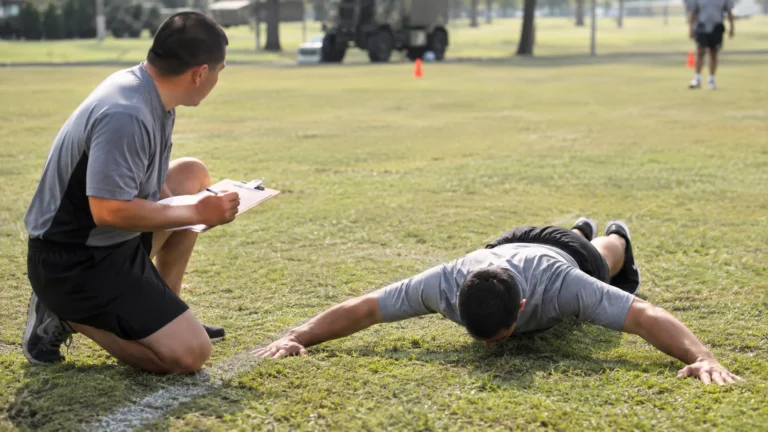
“Primary events” means the five record events. Army Directive 2025-06 lists them as the max dead lift, hand-release push-up, sprint/drag/carry, plank and 2-mile run. The test tops out at 500 points.
Without a profile, combat Soldiers must meet the combat standard. That means at least 60 points per event and 350 total. The standard is sex-neutral and age-normed, and it uses the male scoring column. General standard Soldiers need 60 points per event, or 300 total.
A waiver does not excuse the test. It excuses reclassification. Paragraph 4a(7)(a) says Soldiers with this profile cannot take the Combat Field Test. The Army then evaluates them for MOS or AOC reclassification. A waiver lets you stay in your specialty anyway. If your profile later clears, read what the Combat Field Test involves.
Combat specialties now number 24. They cover infantry, combat engineer, field artillery, Special Forces and armor codes. Army Directive 2026-07 added 12D Army Diver, 89D EOD Specialist and 89E EOD Officer. Some pages still list 21. That count predates the April 2026 directive.
Existing profiles count too. The directive says Soldiers may request waivers for permanent profiles they already hold. The same applies to profiles assigned during the implementation period.
That period runs one year from the directive date. During it, the Army takes no administrative action based solely on a profile that blocks the CFT.
Can You Get a Waiver for the AFT If You Are Not in a Combat MOS?
No formal waiver exists for general standard Soldiers. Under Army Directive 2025-06, paragraph 4g, you take every event your permanent profile does not prohibit. If your AFT profile rules out the 2-mile run, you take an alternate aerobic event. That event is graded go/no-go, not on the 0 to 100 scale.
You must receive a GO on the alternate event. Read how alternate events are graded before test day. Only a certified grader entering your result in DTMS makes the score official.

Waiver vs Profile vs Exemption
Three terms get mixed up in barracks talk. This table sorts them.
Item | Combat MOS waiver | Permanent profile | 465-point exemption |
|---|---|---|---|
Who it covers | Combat specialty Soldiers with an AFT-limiting profile | Any Soldier with a permanent profile | Former high AFT scorers |
What it does | Protects you from reclassification | Sets which events you take | Excused body fat assessment |
Who decides | GCMCA or first GO | Profiling officer and approval authority | Nobody. It is rescinded |
Record AFTs still required? | Yes | Yes | Not applicable |
Source | Army Directive 2026-07 | Army Directive 2025-06; AR 40-501 | Rescinded by Army Directive 2026-13 |
Is There Still an AFT Exemption?
No. The only AFT exemption most Soldiers knew was the 465-point body fat exemption. Army Directive 2026-13, effective 7 July 2026, rescinded it. The same directive dropped the tape test and the height and weight tables. A waist-to-height ratio under 0.550 is now the sole standard.
A high score no longer covers you on body composition. Read why that exemption ended, then check your waist-to-height ratio.
What Is DA Form 3349?
DA Form 3349 is the Physical Profile Record. Your provider builds it in e-Profile, the Army’s electronic profiling system. It lists your duty limits by condition and your PULHES ratings. Section 4 covers basic functional activities every Soldier is expected to perform.
This form is the starting point for any waiver request. The approving officer needs to see what your profile blocks.
A permanent profile Army providers rate as 3 or 4 in any PULHES factor triggers a review. AR 40-502 sets two paths. Soldiers who meet medical retention standards in AR 40-501 go to the MOS Administrative Retention Review, called MAR2. Soldiers who do not meet them go to the Disability Evaluation System. There, a Physical Evaluation Board (PEB) decides fitness for duty.
Timing matters here. AR 40-502 defines the Medical Retention Determination Point (MRDP). You reach MRDP when your condition stabilizes, or cannot stabilize within up to 12 months, and it affects duty.
These boards run on their own track. A MAR2 or PEB rules on medical retention. The waiver answers a narrower question about keeping a combat specialty.
Which Commander Holds Waiver Authority?
Authority sits with the general court-martial convening authority (GCMCA). It can also sit with the first general officer in your chain of command. That is paragraph 4a(7)(b) of Army Directive 2026-07. Your company and battalion commanders do not hold this authority. They send recommendations up the chain.
Soldiers often call it a general officer waiver for that reason.
What Does the Approving Officer Weigh?
The directive names four factors. The first is occupational requirements in DA Pam 611-21. The GCMCA or first GO also weighs your performance and your chain of command’s recommendations. Last comes your ability to meet MOS or AOC requirements. A strong duty record helps, and so does a commander who backs you in writing.
Ask your S1 what your command wants in the packet. Requirements vary by installation, so get them in writing.
Denials can be appealed. You send the appeal to the next higher commander in your chain. If no such commander exists below Headquarters, Department of the Army, the Deputy Chief of Staff, G-1 hears it.
How Scoring Works on a Waiver
You still take record tests. Paragraph 4a(7)(c) of Army Directive 2026-07 keeps waiver holders on the annual 2-AFT requirement. Some Reserve Component Soldiers take one per year instead. That covers those not on AGR orders or active duty orders of 365 days or more.
Army Directive 2025-06, paragraph 4g, sets the pass rule for combat Soldiers on profile. You must average 70 points or higher across the events you can take.
Events your profile allows | Minimum total to pass |
|---|---|
4 events | 280 points |
3 events | 210 points |
2 events | 140 points |
1 event | 70 points |
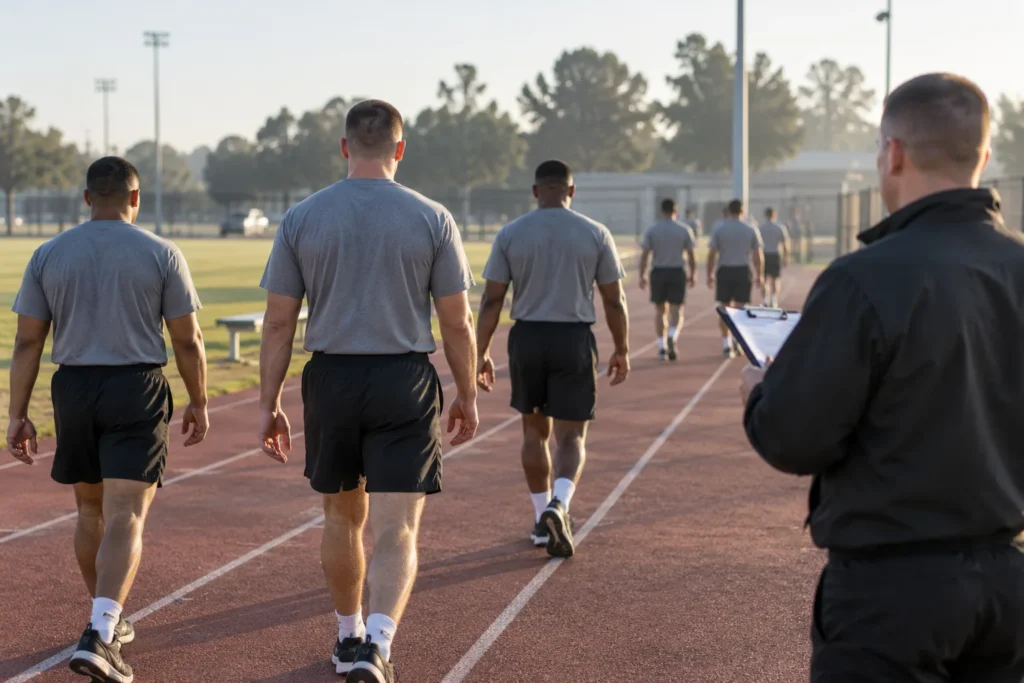
Promotion scoring gets a floor. For semi-centralized promotions, you receive 70 points for a GO on the alternate aerobic event. You also receive 70 points for each event your profile prohibits. Plug your event scores into the AFT calculator to see where you stand.
The Annual Review
Your waiver gets a fresh look every year. Paragraph 4a(7)(d) tells the GCMCA or first GO to review all profiles under their authority. They must reassess whether each waiver still applies. Approval this year does not promise approval next year.
Track any change to your DA Form 3349. A new profile can change the answer at your annual review.
Keep copies of your approval memo and every profile update. A new commander may ask to see them.
What Happens If the Waiver Is Denied?
You face reclassification or a branch transfer. Enlisted Soldiers who refuse to extend or reenlist for it, or cannot reclassify, face separation. That runs under AR 635-200, chapter 13, or AR 135-178, chapter 9. Officers face elimination under AR 600-8-24, paragraph 4-2(a), or AR 135-175, paragraph 2-12.
Frequently Asked Questions
What to Do Next
If you hold a combat MOS and an AFT-limiting profile, start your AFT waiver request early. Bring a current DA Form 3349 to your S1. Ask your commander for a written recommendation. Keep training every event your profile allows, and check your numbers against the official scoring tables.