CORRECTION
AFT Retest Window: 90 and 180 Day Rules by Component
How long each component has to retest, what stops the clock, and who sets the date. Sourced to Army Directive 2025-06.
You have 90 days to pass an AFT retest if you are active duty or AGR. Reserve Component Soldiers have 180 days. Many websites still publish 120 to 180 days. That figure comes from the retired ACFT policy and no longer applies.
The Army Fitness Test replaced the ACFT on 1 June 2025 under Army Directive 2025-06. The retest rules changed with it. This page lays out the window for each component, what stops the clock, and who sets your test date.
How Long Do You Have to Retake the AFT?
How long you have to retake the AFT depends on one thing: your component. Active duty and AGR Soldiers retest within 90 days of the failed record test. Reserve Component Soldiers retest within 180 days.
A failure means you scored under 60 points on any event. The general standard is 300 total, which is 60 points across five events. Soldiers in the 24 combat MOSs need 350 total, with at least 60 on every event. You can check the point tables for your age bracket to see what each event demands.
The table below shows each window next to the outdated figure. The source for the current windows is Army Directive 2025-06 and the Army’s AFT page.
Component | Retest window | Governing policy |
|---|---|---|
Regular Army (active duty) | Within 90 days | Army Directive 2025-06 |
Active Guard Reserve (AGR) | Within 90 days | Army Directive 2025-06 |
Army National Guard, traditional | Within 180 days | Army Directive 2025-06 |
Army Reserve, drilling | Within 180 days | Army Directive 2025-06 |
Outdated figure, do not use | 120 to 180 days | Army Directive 2022-05 (retired ACFT policy) |
Sources: Army Directive 2025-06 for rows one to four. Row five is the retired ACFT figure from Army Directive 2022-05.
AFT Retest Window Active Duty and AGR: 90 Days
Active duty Soldiers train every duty day, and AGR Soldiers serve full time. Both get the same 90 days. The count starts on the date of the failed record test.
Ninety days is about 13 weeks. That is enough time to fix one weak event if you start in week one. Get a test date on the calendar early so your training has a target. Then score your last test event by event and see where the points went.
Is the Window Different for the Guard?
Yes. The AFT retest window National Guard Soldiers follow is 180 days, the same as the Army Reserve. Both belong to the Reserve Component. You drill a few days a month, so 180 days holds far fewer training days than it sounds. One exception applies. Guard and Reserve Soldiers on AGR status follow the 90 day rule.
Does the Old 120 to 180 Day Figure Still Apply?
No. The 120 to 180 day figure is the most repeated error on this topic. It belongs to Army Directive 2022-05, which governed the ACFT. The ACFT ended on 1 June 2025. Under the AFT, active duty and AGR Soldiers get 90 days. The Reserve Component gets 180 days. A page that lists six events or a Standing Power Throw is out of date.
How to Count Your Window
Count calendar days from the date you failed. Weekends and holidays count. Here are two examples using a failed record test on 3 March.
Soldier | Window | Last day to retest |
|---|---|---|
Active duty or AGR | 90 days | 1 June |
Reserve Component | 180 days | 30 August |
Mark the last day, then work backward. Reserve Component Soldiers should check the drill schedule first. Your last day may fall between drills, so your real deadline is the drill before it. Write the date down the day you fail, and give a copy to your first-line leader.
Does Profile Time Count Toward the Window?
It does not. Profile time excluded is the rule in short form. Days you spend on a temporary profile do not count against your 90 days or 180 days. The clock stops while the profile is active and starts again when it ends.
Take the active duty example above. A 20 day temporary profile moves the last day from 1 June to 21 June. Keep a copy of the profile with its start and end dates. Your leaders need those dates to count the window correctly.
Some injuries do not clear. If your condition reaches the Medical Retention Determination Point (MRDP), your provider reviews you for a permanent profile. A permanent profile can change which events you take. Alternate aerobic events are graded go/no-go, not on the 0 to 100 scale. Read how the go/no-go events are run before you test on one.
What to Do Between the Failure and the Retest
Start with the event you failed. Find the gap between your score and 60 points. You can enter your raw numbers here to see how many reps or seconds you need.
Your unit will likely place you in remedial PT. The name varies by unit. The purpose is the same everywhere: extra training aimed at your weak event. FM 7-22, Holistic Health and Fitness, is the doctrine behind unit physical training.

FM 7-22 also covers Army reconditioning, the program for Soldiers returning from injury. Reconditioning rebuilds you in stages before you rejoin full unit PT. Ask your leader which program fits you if you are coming off a profile.
A failed record test also brings a flag. See what the flag stops while you wait so nothing surprises you.
Can You Retake a Single AFT Event?
Soldiers often ask, “can you retake a single AFT event” after failing only one. Plan on taking all five. The AFT is one record test, and the 60 point minimum applies to every event on it. We could not find a single-event retake rule in the directive, so we do not claim one. Confirm with your certified grader.
Who Schedules the Retest?
Your commander does, through your chain of command. You do not book it yourself. A certified grader runs the test and enters the result into DTMS. Only that DTMS entry counts as an official score.
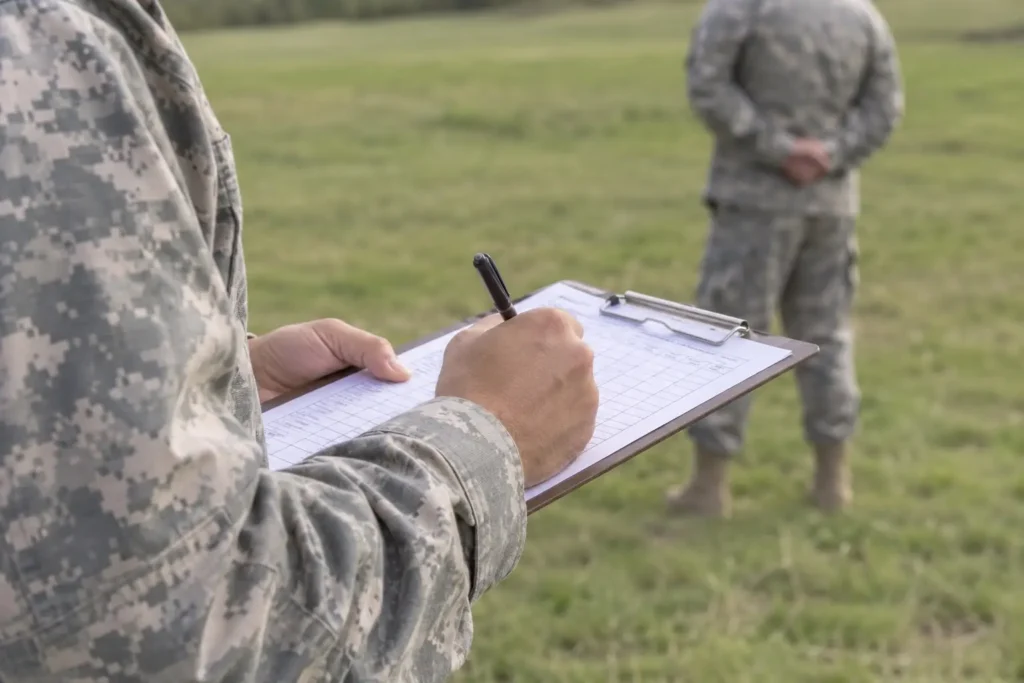
A practice test with your squad leader does not close the window, even if you pass every event. Ask your first-line leader for the record test date as soon as you fail. If the date slips, raise it early instead of waiting for the final week.
FAQ
Your Next Step
Find your component in the first table and count forward from your failure date. Add back any profile days. Then ask your chain of command for a test date and train the weak event first. Pass the AFT retest inside your window, and confirm the score shows in DTMS.